Bill McNutt (guest author)
Actually, I wasn’t there, but it was close. The original “Dungeons and Dragons” ruleset was published in 1974 as a set of heavy pamphlets. It had a first printing run of a whopping one thousand copies. Artists were paid one dollar for a small picture, and two dollars for a large one. Entertainingly, this edition is NOT generally referred to as “First Edition.” When speaking of ancient tabletop history, this is “the Box Set.” Collectors, when speaking of the “Box Set” will refer to “Brown Box,” which is almost impossible to find, or “White Box,” which is a later reprint. It came with a set of low-quality plastic dice and a crayon you could use to fill in the dice numbers to make them easier to read.We called those “low-impact dice” because if you rolled ‘em three times, all the corners wore off and the edges rounded over. After a year’s worth of play, a twenty-sided die could roll around for five minutes before settling on a number.
I actually joined the fraternity of tabletop gamers in 1980, during the run of what we Jurassic geeks called “Advanced Dungeons and Dragons,” so named because the Box Set, still available, was marketed as “Basic Dungeons and Dragons,” whereas the First Edition, available as single volumes, was “AD&D.” “Basic” and “Advanced” overlapped from 1989 – 1991, when “Basic D&D” ceased publication.
One of the key features of this old, coal-burning beast was “the hit tables,” a very concise piece of jargon that was short for what the publishers called “Attack Matrices.” (It was a very Dorky Time. Bear with me.) There were twenty one armor classes, -10 through +10, zero included. Each class of character had a hit table they used, and would look up the armor class of the opponent and cross index it with the skill level of the attacker, add or subtract any bonuses from magic weapons, and that was your target number. Roll D20 to hit. Simple, eh? Trust me, you got pretty quick at it. I they were on pages 74. That’s how often I referred to ‘em. I can still remember the page numbers, and it’s been forty years.
(https://dungeonsdragons.fandom.com/wiki/THAC0 )
Only later, when “Second Edition” came out did we start referring to it as “First Edition.” In my area of coastal South Carolina there was significant resistance to Second Edition when it came out. We were all tweens or teens in those days and had very little money. The First Edition books had been hard-earned, and the Second Edition rules did not dovetail at ALL. It was essentially a new game, and it took two or three years for Second Edition to gain much traction with us.
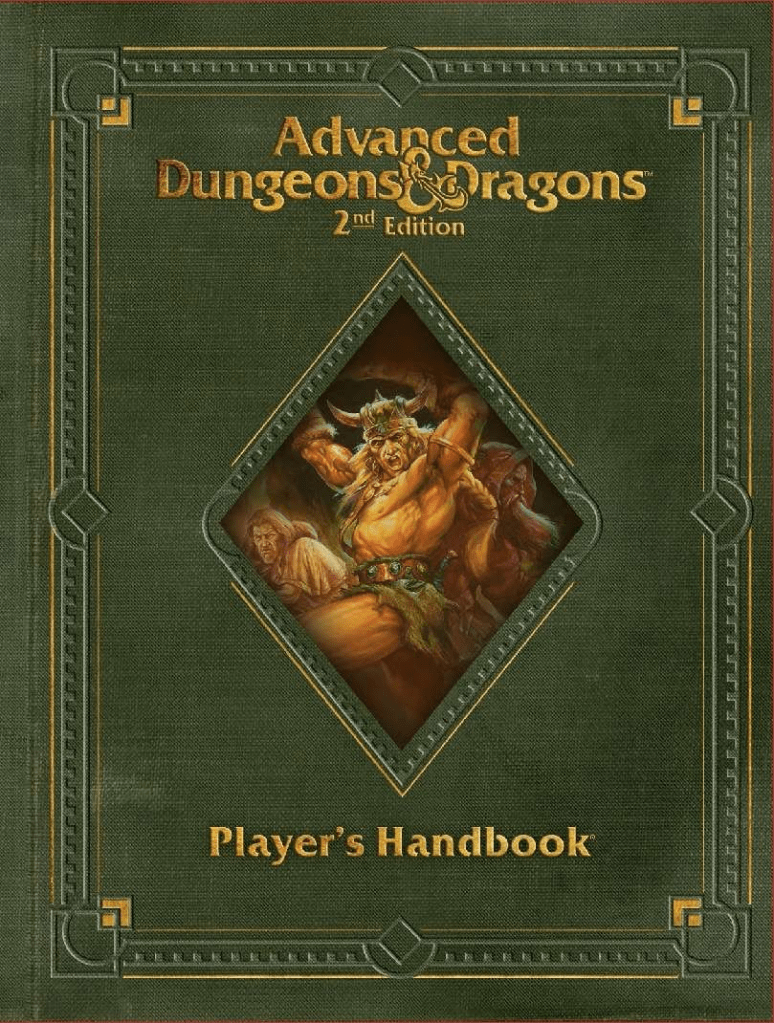
I dragged y’all through the Hit Tables because I wanted to share with you an innovation that came out with Second Edition: The THAC0! Generally pronounced “thay-ko,” if you hear of it anymore, it’s generally in disparaging terms. A bit of arithmetic is required to get your target number and it can be a little awkward in the heat of battle, but compared to the old hit tables, it was a breath of fresh air. Armor class started at zero – no armor – and only went up. There were no negative numbers involved. Each character class had an assigned THAC0 that only had to be updated when you leveled up. Add any bonuses from your magic weapon or situation. Roll a D20 and call out the number to the referee. He doesn’t even need to tell you the target number, although we typically did in those days. There was no point in trying to keep it secret, because there was a particular subset of dork, or at least there was at MY table, that couldn’t help themselves, and they noted down each roll that hit or missed to zero-in on the Armor Class.
We cannot leave Second Edition behind without mentioning a feature that would become legendary across the entire gaming community: the “patented fall-apart TSR binding.” You could tell that you had an authentic copy of a Second Edition TSR hardback, earned by mowing miles of lawns and delivering tons of the Chicago Tribune if the spine had fallen off. Literally, as soon as you opened these books for the first time, you’d hear an audible crack as the spine split off from the front cover, and it was only a matter of a few months before one or more of the pages would begin its attempts to escape.
I can’t share any memories of Third Edition because I never played it. My local group was content with Second Edition and Third Edition didn’t add any features we needed. And it was just as well. Very quickly a new edition followed on its heels: “Dungeons and Dragons – 3rd Edition Revised.” It was almost immediately christened “Three-Point-Five.”
The topic of 3.5 is somewhat sensitive even to this day, and was quite the flashpoint back when it came out in 2003. Third Edition was only three years old, and many felt that 3.5 was a mere money-grab by the publisher to boost sagging sales. There were enough subtle changes across the board such that Third Edition and 3.5 looked like the same game, but if you mixed the editions, or just hadn’t mastered 3.5 yet, you were constantly tripping over differences.
To my mind, the biggest change over Second Edition was the introduction of Feats. These are specialized skills that your character accumulates, which make them both more effective and more unique. Is your rogue quick, like the tongue of a snake? Then he needs “Weapon Finesse,” which will allow him to use his Dex (Dexterity) instead of his Str (Strength) on his attack. Need to use your barbarian as an ablative meat-shield to protect those flimsy mages and sorcerers? He needs Durable, which allows him to heal faster during short rests.
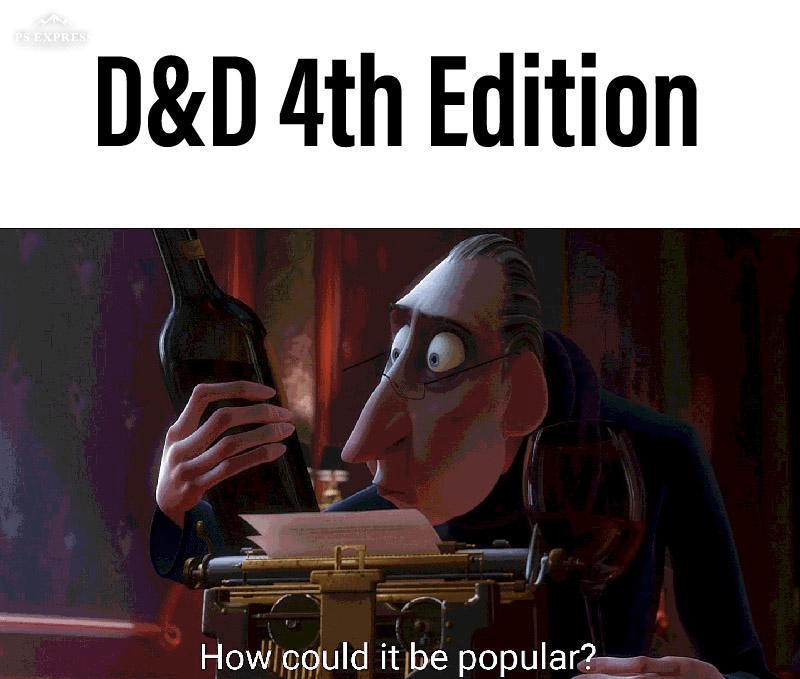
Like the Third Edition, I cannot give you any insight into the Fourth Edition because I never played it. If I recall correctly, Fourth Edition was one of the most poorly received editions of Dungeons and Dragons to be published, although they sold out two print runs during the first release. Somebody must have bought it, despite all the negative noise I heard. My own gaming group, now turning into a bunch of grumpy, middle-aged men, had made a significant investment in 3.5, and it was meeting our needs, so “4e” got zero traction with us. (https://dragonforgehobbies.com/tabletop-rpg-history-why-dd-4e-was-so-controversial/ )
Which brings us to the Fifth Edition, and what is currently in play as of this date (2023).
There was one significant mechanic that was introduced here that I need to mention, Advantage/Disadvantage.
A feat, magical effect, or just the in-game environment can give a character “Advantage” or “Disadvantage” when trying to attempt a task. Need to pick a lock, but you have good light, a full set of Thieves Tools, and all the time in the world? Roll with Advantage. Roll two D20’s and take the better of the two rolls. Picking the same lock with next to no light, a couple of picks improvised from ladies hairpins, with the Watch coming around the corner any second? Roll with Disadvantage. Roll the same two D20’s, but this time you are going to take the worse of the two rolls.
The Advantage/Disadvantage innovation allows the referee/DM/storyteller to quickly and easily raise or lower the chance of success of a given action, providing the players with more opportunity and incentive for roleplay.
For example, “I open the door and attempt to Intimidate the gang,” versus “I kick open the door with a roar, whirling my warhammer about my head and attempt to Intimidate.”
That second one there? THAT gets Advantage.
“I really wanna take this shot.”
“You can do that, but the lighting is very bad here. Roll with Disadvantage.”
Dungeons and Dragons has changed significantly in almost all practical ways in the forty or more years that I have been playing. The current rule set and mechanics would have been unrecognizable to my high-school self, but the core of the game: to sit at a table with your friends and imagine a world of high (or low) adventure remains, as has the goal: to crush your enemies, see them driven before you, and stack up a big pile of magic items.
About the Author
Bill McNutt has been a tabletop gamer since about 1978 when he first encountered “Chivalry and Sorcery” in his freshman year in high school. In the ensuing decades he has played many different games systems through many editions, Traveller, AD&D, Hero Systems (Champions), and Savage Worlds being the most predominant. Bill has written over thirty modules to various degrees of completion for use in games he has refereed, and as a player has spent Friday nights around the table since some time in the Carter Administration.
 RPG Counterpoint
Leave a comment