by: Max Sirak of Peak DnD
What if I told you I could help make your games – whichever ones you play – better?
And I’m not talking a little bit better. I mean a lot better.
Better than sex.
Better than drugs.
Better than love.
Would you hear me out?
Ok, Hold On A Second
Leave it to sex and drugs to pique interest and grab attention.
Bold claims, I know. Let me do my best to back them up. Starting with everyone’s favorite, neuroscience! Ta-da!
See, the reason sex, drugs, and love feel as good as they do is because of what they do to our brains. They release specific chemicals or hormones that latch onto equally specific receptors that then flood our bodies with feel-good chemicals.
Enjoying sex and love is hardwired into our DNA. We are, quite literally, programmed to seek them out. And as a result, reap tremendous neuro-chemical rewards when we pass the requisite skill checks to succeed at getting them.
Functionally, drugs are similar. Once taken, they make their way through the body, get to the brain, and short circuit it, releasing a cocktail of feel-good chemicals. The brain basks in the bounty of these neuro-chemicals to the point of drowning out all others.
As Tymora – The Goddess of Luck – would have it, there is something that does an even better job than sex, drugs, or love at bathing our brains.
Group flow.
Group Whaaaa?

Group flow is the name we give the experience of multiple people synchronizing. Unfortunately, as is the case with most feelings, words don’t do it justice. Group flow is something that has to be felt.
Also known as collective effervescence, group flow happens when groups of people act and think in a like way, and lose themselves to something bigger. Think: crowds at sporting events, religious congregations, teams on their courts or fields, bands on stage, attendees at a concert.
I’m guessing – hoping – since it’s just one of the most satisfying states known to humans, that you’ve had the chance to experience group flow.
Maybe you were performing with others on stage, playing a game, or boogieing down at a concert. Time dilates, either slowing down drastically or whooshing by, in moments like these. There’s a sense of effortlessness or ease to your actions. Things just work, are easy, and feel good.
Moments like these are something I’m sure you’ve experienced alone, too. Video games are masterfully constructed to drop us into flow. Individual flow rocks. Think of it as “level one” flow. Group flow is “level three”. In between is interpersonal flow. Conversations being the most PG example of level two flow.
Our guess at the reasons for this hierarchy of flow is in our origins. We are social, story-telling mammals. Working together in groups toward common goals is what allowed us to claw our way to the top of the evolutionary ladder. At least, this is a hypothesis as to why we release more feel-good chemicals while working with others, toward a common goal, than doing anything else.
Group Flow. Count me in. Now – How?
Remember – group flow is an experience. And, like all experiences (especially psychedelic ones), it is a product of “set and setting.” Meaning – there is no magic bullet that will guarantee you and your group get into group flow. There are, however, initial conditions you can set, a style of play you can practice, and something you can abstain from that will set the stage for group flow to emerge in your TTRPG sessions.
Initial Conditions
Flow, in all its forms, has a dastardly duo of Big Bads. The first is confusion. We’ll get to the other in a sec.
Confusion kills flow. Which, consequently also means, clarity drives it. Setting the stage for group flow means doing a few things to ensure the entire group, GM and players alike, are on the same page.
THIS DOES NOT MEAN SPOILERS. I am not, nor doubtfully ever will, advocate that Game Masters do anything to ruin the surprise for the players.
What this does mean is bookending your game sessions with two quick conversations.
Start each of your sessions with a broad overview of where you are now and how you got there. Recount what happened last session. Include whatever was the most fun or memorable part. And then, set clear goals for the session ahead.
(Ex: Last time we were in the dungeon, Tony set off that trap that screwed us, and we left off about to open this door; We made it out of the dungeon, mostly thanks to Peter for doing that one thing, got town to town, and now are about to spend our hard earned loot!)
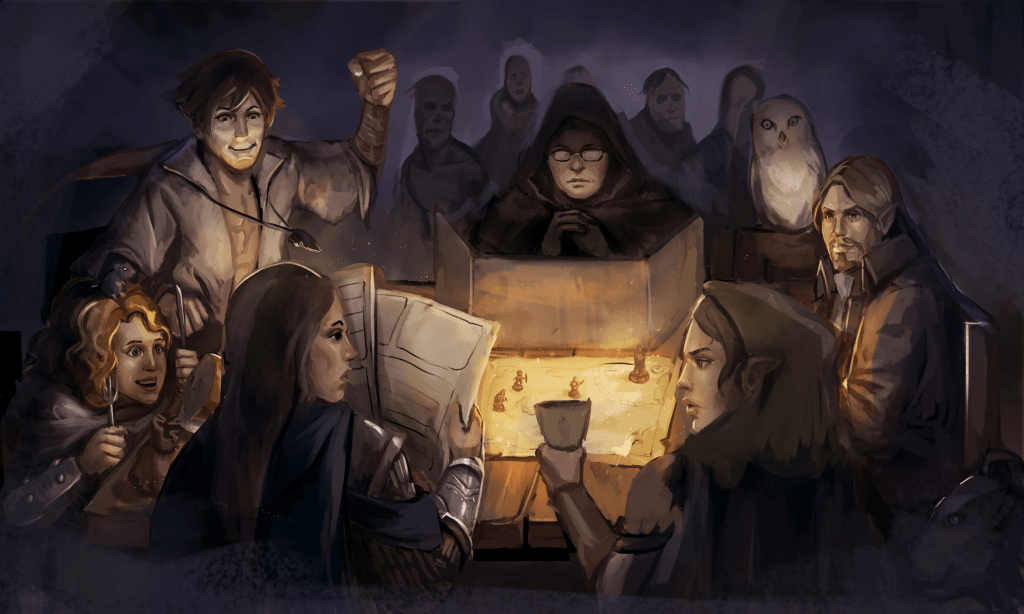
See? No spoilers. Just a simple recap followed by the next step the group is taking.
Then – after your amazing time laughing, having fun, and playing with your friends – end your session with an equally quick conversation.
“Wow, gang. That was super fun! <rehash shenanigans>. Where does it look like we’re heading next week/session?”
This gives your GM a sense of what to prepare for next time.
Style of Play to Practice
The first study of group flow was done by the psychologist, Keith Sawyer, while he was studying at the University of Chicago. Chicago is a cool town. One thing it has going for it is a legendary improv comedy scene.
Sawyer recorded a bunch of Second City performances. He started by listening, paying close attention to the eruptions of laughter from the crowd. Next, he’d watch, focusing this time on what was happening on stage during the uproars. This led to insights.
The first was, “Yes, And” – the cardinal rule of improv (and incidentally PeakD&D). The concept is simple: Always. Be. Additive. To your other players. To your GM. To your game.
“Yes, And”-ing players means responding positively and constructively to their ideas, regardless of how bad or doomed to failure you think they are. Say something like, “Ok…ok….I like <insert some crumb of goodness from their suggestion>. What if we added <your idea> to it?”
“Yes, And”-ing GMs means cooperating with the story they are trying to tell and the session they are trying to run. I’m not saying you have to color in the lines. Please, don’t. What I am saying is that you need to be working on the same page of the same coloring book as your GM.
Giving specific examples of “Yes, And”-ing your GM is harder. It depends on your group. Basically, don’t be a dick and derail the game the nice person is running for you and the other players.
Active listening was Keith Sawyer’s next insight. I know. I know. I know. The game you’re playing is more fun when it’s your turn and the spotlight’s on you.
I get it. We get it. Everyone gets it.
However, being engaged with the game especially when it’s not your turn, helps grease the wheels of group flow. So, stop “checking out” when it’s not your turn.
“What’s ‘checking out?,’” you ask. Scrolling social media. Idling online. Side conversations. Flipping through your sheets/spells, lost in thought about what YOU are going to do next, etc.
Instead of checking out, try commenting or cracking a joke about what your fellow player did on their turn. Not only will this keep you engaged in what’s going on in the game, but it’ll build camaraderie. Which is important, because you’ve got a boss fight coming up…
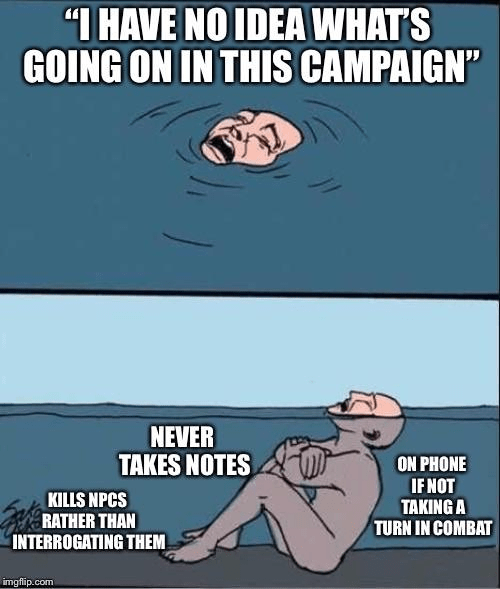
Distraction is main BBEG (Big, Bad, Evil Guy) of Flow
Important enough, I’ll say it again. Only louder. And slower. Because that’s how you get someone to understand what you’re saying. Especially if they don’t speak your language…
Distraction is the enemy of flow. Focus fuels flow. Period.
There’s a reason Silicon Valley executives call their customers “users.” Each of us walks around with a limitless supply of digital cocaine in our pockets. And, if you squint your ears closely, I bet you can hear its siren song.
“Pick me up. Tune out your surroundings and environment. You don’t need them. I’m all the entertainment you need…”
The more you entertain yourself, and willfully “check out” of the game – the less likely you and everyone else will be able to get into group flow.
Don’t believe me? Try it for a night. Keep your phone in your bag. Do your best to not check it. No social media. No scrolling. See how you feel.
There’s a good chance others will pick up on this social cue. And, as the momentum in the game and group builds, people will be less inclined to look at their phones.
Or, if you’ve feeling a bit more Chaotic Evil (yeah, that’s right. I said it. I’m pro-alignment chart), then be the first person to take the Demogorgon out of your pocket and watch what happens.
How long did it take before the next person did the same?
How did it feel, how much were you enjoying the game when over 50% of your group was more engaged with their phone than the game?
If you can’t defeat the Demogorgon on your own, here’s a trick to try. Be like the lifelong smoker who decides to quit cold turkey the first time they hold their newborn. Do it for the others in your group and the group itself.
Neat and Tidy Resolution
Remember how this all started. I told you I could help you make your games be better than sex, drugs, or love. And I have.
Start your sessions with a brief recap. In it, make sure to include what the next step or two is for your group to take. During your session practice “Yes, And”-ing and active listening. End your session with a quick discussion of what your next session is going to look like. And for the love of all the Gods in the pantheon – keep your Demogorgon in your pocket.
There you are. The keys to the group flow kingdom. Guaranteed to you make your games more satisfying and fun. If you use them.
Unfortunately, it’s like the adage says, “You can lead a hippogryph to water, but you can’t force them to drink…unless, of course, it’s 5e and you’re playing a ranger, and that hippogryph is your animal companion, and you’re a Beast Master. Then you can use your action (or is it bonus action?) to actually make them drink.”
(If group flow is something you’re interested in learning more about, we made this video. It goes more in-depth, and comes with a free pdf we made to help you and your group)
Notes
- “Drugs, Brains, and Behavior: The Science of Addition,” National Institute of Health, 2022, March 22. https://nida.nih.gov/publications/drugs-brains-behavior-science-addiction/drugs-brain
- “Tymora,” Forgotten Realms Wiki, Fandom, accessed Aug 8, 2023
https://forgottenrealms.fandom.com/wiki/Tymora
- “The Second City,” The Second City, accessed Aug 8, 2023
https://www.youtube.com/@secondcitynetwork
- “PeakD&D,” PeakD&D, accessed Aug 8, 2023
- “The Demon In Your Pocket,” PeakD&D, accessed Aug 8, 2023
- “6 Ways To Fuel The Fun At Your Table,” PeakD&D, accessed Aug 8, 2023
 RPG Counterpoint
Leave a comment