From Guest Author, Ryan Germain
The concept of alignment in Dungeons & Dragons (D&D) has long been a contentious topic within the gaming community. Many players consider it a relic of the game’s early editions, others argue that it lacks usefulness in crafting stories and characters. To truly appreciate the significance of alignment in D&D, it is imperative to delve into its historical roots and understand how this concept has evolved over time. By tracing its development, we can gain valuable insights into not only what alignment represents but also why it should remain an empowering aspect of the game. A closer examination reveals its utility in shaping characters, narratives, and the very essence of the tabletop RPG experience.
It is crucial to acknowledge that the concept of alignment in D&D and other RPGs is often viewed as outdated by many players. To fully appreciate its significance and relevance in the context of the game, it’s essential to understand the historical use of alignment. By understanding its evolution, we gain insights not only into what alignment means, but also its uses.
| These planes are the homes of the deities and the source of alignment (religious/philosophical/ethical ideals). There is an exact correspondence between alignment and the Outer Planes. Figure 4 and Figure 5 can be used to visualize this more clearly. Note that the alignment positions on the Character Alignment Graph match up exactly with the Outer Planes of identical alignment. There are nine basic alignments, and nine planes which correspond to those alignments. There are also eight other planes between the nine which represent “borderline” alignments. As Fig. 4 shows, alignment is a matter of degree rather than absolute definition. Thus, a lawful evil character who tended towards neutral evil would probably end up in Gehenna rather than Hades or the Nine Hells.~ Deities & Demigods p.131, 1980[1]   |
Personally, the most direct utility of having alignment in a monster’s stat block is best addressed in the AD&D DMG:
Alignment describes the broad ethos of thinking, reasoning creatures — those unintelligent sorts being placed within the neutral area because they are totally uncaring. Note that alignment does not necessarily dictate religious persuasion, although many religious beliefs will dictate alignment. As explained under ALIGNMENT LANGUAGES (q.v.) this aspect of alignment is not the major consideration. The overall behavior of the character (or creature) is delineated by alignment, or, in the case of player characters, behavior determines actual alignment. Therefore, besides defining the general tendencies of creatures, it also groups creatures into mutually acceptable or at least non-hostile divisions. This is not to say that groups of similarly aligned creatures cannot be opposed or even mortal enemies. Two nations, for example, with rulers of lawful good alignment can be at war. Bands of orcs can hate each other. But the former would possibly cease their war in opposing a massive invasion of orcs, just as the latter would make common cause against the lawful good men. This alignment describes the worldview of creatures and helps to define what their actions, reactions, and purposes will be. It likewise causes a player character to choose an ethos which is appropriate to his or her profession and alignment also aids players in the definition and role approach of their respective game persona. With the usefulness of alignment determined, definition of the divisions is necessary.[2]
Rather than being used to limit the DM’s creativity, it can help establish connections and guide the plot. It establishes general principles of how to run entire cultures and how they might interact. While alignment is often considered in the terms of individuals, or disparaged for its stereotyping of cultures in a vacuum, it is mostly a tool to establish relationships and motivations for roleplay. It’s important to note the use of “can” in Gygax’s examples. These are likelihoods, not hard and fast rules of how to interpret alignment (after all, the Always Chaotic Evil members of the same orc tribe can work together, and the noble Lawful Good rulers still see a reason to commit the barely Lawful and rarely Good act of warfare against each other in the first place).
In spite of the popular notion that Alignment is an outdated relic from the earliest editions, the concept underwent dramatic changes between Advanced and 2nd edition. Here’s the section on changing alignment in AD&D’s DMG:
Whether or not the character actively professes some deity, he or she will have an alignment and serve one or more deities of this general alignment indirectly and unbeknownst to the character: Changing of alignment is a serious matter, although some players would have their characters change alignment as often as they change socks. Not so!
[…] Although it is possible for a character to allow himself or herself to be blown by the winds as far as alignment is concerned, he or she will pay a penalty which will effectively damn the character to oblivion.
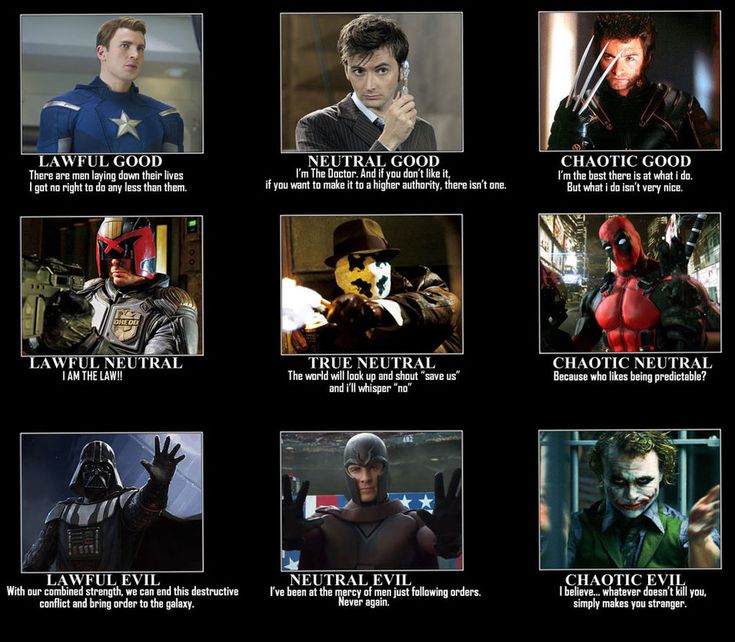
A glance or the alignment chart will show that radical alignment changes are impossible without magical means. If one is chaotic good, it is possible to change to neutral good or chaotic neutral only, depending upon desire and/or actions. From the absolute neutral alignment can only move to some neutral-based alignment. This represents the fact that the character must divorce himself or herself from certain precepts and views and wholeheartedly embrace another set of values, and human nature is such that without radical personality alteration (such as caused by insanity or magic in the case of this game) such transition must be gradual.[3]
Before we get into the differences, I want to make a note. Gygax is obviously emphasizing the mechanical consequences of changing alignment. Remember that in older editions, alignment was considered a prerequisite for many character options, and to allow an apathetic view on the more ethereal requirements would invite metagamers to simply have their paladins act like monsters just to collect the specific build option they’re looking for.
But that’s not the only thing Gygax is emphasizing.
This represents the fact that the character must divorce himself or herself from certain precepts and views and wholeheartedly embrace another set of valves, and human nature is such that without radical personality alteration (such as caused by insanity or magic in the case of this game) such transmission must be gradual.
Gygax recognized that, despite the mechanical consequences he really didn’t want to entertain, characters do change in views. It’s not a whim, it’s a change in perspective and philosophy. The “gradual” clause is mostly a necessity of mechanics, but it’s one that makes sense in most cases: a character undergoes an arc that changes their philosophy over time. Most characters in media don’t undergo dramatic alignment shifts (think of redeemed villains) in a single action – their arcs gradually accumulate reasons to change.
Gygax continues:
It is assumed that the character’s initial alignment has been his or hers for a considerable period prior to the character’s emergence as an adventurer. This ethos will not be lightly changed by a stable, rational individual, it is recommended that you do not inform players of the penalty which will occur with alignment change, so that those who seek to use alignment as a means of furthering their own interests by conveniently swapping one for another when they deem the time is ripe will find that they have, instead, paid a stern price for fickleness.
We see more evidence of this philosophical inertia, now as a reason for why a character has an alignment in the first place. Unfortunately, it’s still colored by Gygax’s opinion that the DM is the adversary of the player, but the intent to avoid metagaming is clearly stated. The point is that alignment is a serious trait of a character, as much as (if not more than) their race and class.
We can see clearly that alignment is not prescriptive, but descriptive. Characters, whether Player or otherwise, treat alignment as shorthand for their attitudes and behaviors, which can change based on the plot and player choice. It doesn’t control the player’s actions, nor does it change at the drop of a hat or on a whim. As stated in 3e’s Champions of Ruin, “
Either the player or the DM should assign alignment according to the preponderance of the character’s actions; if he occasionally does good things but most often resorts to evil ends to justify his evil means, he should be given an Evil alignment no matter what his objections.”[4]
In 4th edition, one of the most heavily criticized changes was to the alignment system. By investigating the changes made (and reversed for 5th edition), we can gain a better understanding of the purpose of the alignment system. Rather than the traditional grid of 9 alignments, 4e instead opted for a simplified 5-point scale. This system placed Chaotic Evil and Lawful Good on either end of a spectrum, with am “Unaligned” in the center, and a simple “Good” and “Evil” to either side of it. This system was frequently criticized for its lack of nuance and radical definement of the moral axis. A character that would be Neutral on the moral axis in other editions is now “Unaligned,” offering even less descriptive power than the alignment held in other editions. The concepts of Chaos were intrinsically linked to Evil, and Law to Good. The difference between a purely Chaotic character and a Chaotic Good character was erased, and the system implies that a Chaotic Good character has more in common with a Chaotic Evil one than a Lawful Good one. To whatever extent the 9-alignment system has garnered complaints, the more simplified 5-alignment system has taken more. If we focus on this problem, we can see that the primary complaint of the alignment system is the loss of descriptive nuance, not, as Wizards of the Coast may have thought, that the 9-alignment system was too complex.
While one could overcorrect in the opposite direction (adding more than 9 alignments), this runs the risk of the slippery slope of discounting alignment in favor of a far more abstract “no alignment” system that merely uses adjectives to describe characters. While this may be aimed at capturing specificity and nuance, such a system trends towards creating more confusion at the table, with vastly differing ideas about what defines the colloquial understanding of “Liberty.”
5e has made the commendable move towards a “Persona” field to more comprehensively describe character. Traits, Bonds, Ideals, and Flaws can much more specifically describe and direct a character than mere alignment. But it’s worth emphasizing the influence alignment has over this new system. While the more recent publications have shortsightedly shied away from it, most of the sourcebooks involving Ideals tables (even for monsters!) tag each Ideal with an alignment axis. Many are even tagged with “Any” to show that alignments are not so draconically separate to the extent that some values can’t be taken from different perspectives. The most simple way to conceptualize alignment, in my opinion, is to take a look at the NPC Ideals table in the 5e DMG (p. 90), which uses very archetypical, very grand, values associated with each alignment axis. Each person who reads this table will probably have a different idea of what exactly a character who follows that Ideal will look and act like, but those differing concepts will still be pretty decidedly in-step with the alignment. No philosophical debate needed.
5e may superficially seem to adopt the solution proposed for 4e: taking on more explicitly descriptive elements in lieu of a codified alignment. But this is mistaken. In the original publishings, these Background tables explicitly link Ideals to the standard alignment system, and also provide a sentence or two to further explain their definition. Multiple backgrounds may have the same Ideal (and connect that Ideal to the same alignment axis), but their explanations can veer off in different directions:
“Logic. Emotions must not cloud our sense of what is right and true, or our logical thinking. (Lawful)” ~ PHB 134, Hermit
“Logic. Emotions must not cloud our logical thinking. (Lawful)” ~ PHB 137, Sage
The suggestion for a Hermit’s ideal of Logic is much more morally focused than the Sage’s, but both are certainly Lawful concepts. Ideals can certainly assist in explaining the focus of a character’s alignment in nuanced ways, but still inherently reference the alignment system in order to be fully understood in the context of the character. New publications in 5e have been shying away from alignment due to popular perspectives. Let’s evaluate these new Ideals by the same metrics that alignment has been criticized for:
“Obsession. I’ve lived this way for so long that I can’t imagine another way.” ~ Van Richten’s Guide to Ravenloft, 34
Obsession is considered an Ideal, a value? Surely, this would be more appropriate as a Flaw or even a Bond - an aspect of the character’s identity as opposed to something the character measures themselves by, as defined in the PHB (“Your ideals are the things that you believe in most strongly, the fundamental moral and ethical principles that compel you to act as you do. Ideals encompass everything from your life goals to your core belief system.” ~ PHB 124). This has gotten to the point that source materials released after this publication that include backgrounds (Astral Adventurer’s Guide, Bigby Presents: Glory of the Giants) completely lack suggestions for persona. Removing alignment has removed character, nuance and all.
For those still skeptical of alignment’s ability to provide nuance, I suggest adopting the same model used in AD&D/Planescape in regards to the Outer Planes. Rather than 9 alignments, neighboring alignments can blend together to adopt mixed traits. Rather than their being the implication of a clear delineation between Lawful Evil and Neutral Evil, look instead at a “Lawful-Neutral Evil” (or “Neutral Evil with Lawful tendencies”). While this may seem clunky, consider the differences in theme between the planes of these alignments. Baator (LE) certainly appears similar to Gehenna (N-LE), but is fairly distinct from Hades (NE). The apathetic and nihilistic themes of Hades may be too Neutral for a Neutral Evil character’s ethos, but they’re not quite beholden to the hierarchies and rigid structures of the devils of Baator. In the middle, we find the back-stabbing cutthroat hierarchy of the Yugoloth mercenaries of Gehenna. With a focus on the themes of the Outer Planes as they pertain to alignment, this 17-alignment system isn’t as clunky as may first appear, while still providing the descriptive nuance sought from the 9-alignment system.
For PCs, it’s already been discussed how alignment can be used to ease players into roleplay: providing guidance on character motivation and values. But it’s an aid for memory, as well. Since alignment is based on actions, not decrees, a player can refer to their alignment (or records of how that alignment has changed) and have a better understanding of the campaign’s arcs. It organically avoids the “I have no memory of this place” joke in regards to returning to a game after a long hiatus.
For DMs, alignment can help plan encounters. It is a common grumble of Forever DMs that it’s hard to predict the actions of players. Centering adventure plots on your players’ alignments can help narrow the field of what is necessary to plan for. A party of mostly non-Good characters is likely not going to be interested in charity work, so motivation for an adventure should be based on money, and the DM should have more fleshed-out plans for PC actions that aren’t selfless. A party of mostly Chaotic characters should be easier to motivate into action by portraying infringements on freedoms. A recurring piece of advice from Ravenloft (from 2e all the way to 5e) is to center your antagonist around your party, and alignment helps you extend that advice to any campaign.
As a DM featuring alignment, you should take pains to differentiate between monsters. This is a fundamental aspect of game design that is featured in role-play-heavy non-Tabletop games. The conversation systems of many games have to shorthand an NPC’s persona to account for the limited interactions a player may have with the character. Games like the modern Deus Ex entries even offer full psychological reports so the player can more accurately persuade an NPC. With alignment, all one needs to do is showcase their values. Not only does this mean the plots and actions of Chaotic Demons and Lawful Devils can be more distinct, but that players have the opportunity to effectively speak to these monsters and be rewarded for attentive roleplaying. As the DM, you can showcase the Chaotic and Evil stereotypes of Demons, which mentally preps players to push the correct buttons when speaking with a Demon they may not have the martial ability to handle at the moment. Many summoning spells in 5e, such as Infernal Calling and Planar Ally, emphasize that the creature summoned must be persuaded to assist the caster. Without alignment informing the player’s decisions, the DM is encouraging the player to waste these high-level spells and costly material components on a negotiation with a monster they don’t understand. It is fully understandable that a DM may not want to draw attention to a diverse cast of players’ differing alignments, but alignment as an informative tool to the players is as valuable as teaching a spellcaster the difference between attack rolls and saving throws.
Alignment certainly has its drawbacks. On one end, a player shouldn’t be expected to read a philosophical treatise in order to grasp a single aspect of their character’s attitude. On the other, disregarding these concepts has led to the popular perspective that alignment lacks nuance, or that it is rigidly prescriptive. Alignment should be considered as a model. Models do not fully encapsulate or explain the intricacies of the system they model (think of any model of a solar system or atom), but are immensely helpful in abbreviating the concept for a faster understanding.
There are many half-baked alternatives to alignment, many of which are borrowed from systems not equipped for the D&D game. Consider the “Morality Meter” popularized by video games such as Mass Effect, Fallout, and Fable. Even in cases where the language avoids direct correlations with Good and Evil (Mass Effect’s Paragon and Renegade meters, for example), such instances are poorly defined and nuance is entirely absent. A character that pathologically pickpockets can have the same Karma as one who eats people in Fallout (it’s also worth noting Fallout 4 has removed the Karma system entirely, while Fallout 76 was originally planned to lack NPCs), the same being true for one that charitably aids anyone who asks in Fable but enjoys crass jokes when interacting with NPCs.
A popular replacement has been an import from another Wizards of the Coast property, Magic: The Gathering: the Color Pie.

Despite its designers’ insistence that Black is not Evil, Evil characters consistently run Black, even when they are not necessarily antagonists. Are you starting to see some similarities, already? Characters that uphold legal systems and hierarchies are White, and those opposed to them in support of emotions and freedom are Red. Do you see it? This is no different than the 9-alignment system, only it determines that logic is its own alignment, and that Peace and Harmony (White and Green, respectively) are confusingly distinct concepts. If you are still in denial, look no further than Wizards’ own PlaneShift material – semi-official conversion kits for MTG to D&D. In the PlaneShift: Ixalan source[5], the appendix constructs the following translation:

By all means, if it assists you or another player in understanding the 9-alignment system, so much the better, but it should not be considered a whole-cloth replacement.
I highly recommend reading through the 5e PHB’s material at the very least first, but the following is a more direct and concise alternative to the 9-alignment system’s language, if not its content:

Alignment is a multifaceted aspect of D&D that transcends its reputation. Its historical evolution showcases its adaptability and relevance in the ever-changing landscape of tabletop RPGs. While different editions and systems have experimented with alternative approaches, alignment’s core principles continue to provide valuable tools for both players and Game Masters. It aids in character development, guides the plot, and offers a means to differentiate creatures and cultures within the game world. While criticisms of oversimplification and lack of nuance persist, alignment serves as a model—a shorthand for character attitudes and values that facilitates a faster understanding without requiring an in-depth understanding of philosophies at character creation. Alignment remains a valuable compass that helps navigate the moral, ethical, and philosophical dimensions of our characters and adventures, enriching the tapestry of storytelling and role-playing that defines the genre.
Further Reading
This article merely discusses the utility of alignment as a system, and discusses its alternatives. For more specific information, refer to the following suggestions.
AD&D 2nd Edition Dungeon Master’s Guide, Chapter 4: Alignment. This section contains the most comprehensive and in-depth treatment of alignment in the published game. It contains examples of how to roleplay an alignment as a character, as well as how those alignments act in political cultures and religious beliefs.
Book of Exalted Deeds. This book (and its counterpart, Book of Vile Darkness) offer guidance and philosophy on playing Good (and in the case of Vile Darkness, Evil). The two books do solid jobs of describing their respective alignment focus in detail with concrete examples. Vile Darkness should be noted to have a swath of trigger warnings, and not all of its concepts have aged particularly well, but it does offer guidance on how to run a game with non-objective alignments (in contrast to the D&D’s cosmology’s understanding of Good and Evil as concrete metaphysical forces) which modern players may find more reasonable. Exalted Deeds is the more generic and player-friendly of the two, and Vile Darkness lacks some counterparts to Exalted Deeds’ content (which is found in Champions of Ruin).
Champions of Ruin. If you’re planning on running an evil campaign, or want to play an evil character, this should be your first stop to understand how to play in a way that is fun for the whole table. Ruin comes with discussions on how Evil characters can work with others, as well as examples of organizations of evil NPCs in the Forgotten Realms setting, and suggestions for the origins of an Evil character.
Planescape 2nd Edition Factol’s Manifesto. For a more direct philosophical discussion of the alignments as factions (with some bleedover). Planescape as a whole really emphasizes the distinctions between the 9 alignments among the 16 Outer Planes (plus the Inner Planes). I also suggest reading through the “Philosophy by Numbers” articles from mimir.net, which includes some non-official discussion and relation to real-world philosophies..
Footnotes
[1] James M. Ward, Robert J. Kuntz, and Lawrence Schick, In Advanced Dungeons & Dragons, Deities & Demigods Cyclopedia: Special Reference Work, (Lake Geneva, WI.: TSR Games), 1980.129–31.
[2] Gary Gygax, “Alignment,” In Advanced Dungeons & Dragons, Dungeon Masters Guide: Special Reference Work, (Lake Geneva, Wisconsin: TSR Games, 1979), 23.
[3] Gary Gygax, “Changing Alignment.” In Advanced Dungeons & Dragons, Dungeon Masters Guide: Special Reference Work, (Lake Geneva, Wisconsin: TSR Games, 1979), 25.[4] Jeff Crook, Wil Upchurch, and Eric L. Boyd, “Philosophies of Evil.” In Champions of Ruin, (Renton, Washington: Wizards of the Coast, 2005), 6.
[4] Jeff Crook, Wil Upchurch, and Eric L. Boyd, “Philosophies of Evil.” In Champions of Ruin, (Renton, Washington: Wizards of the Coast, 2005), 6.
[5] https://magic.wizards.com/en/news/feature/plane-shift-ixalan-2018-01-09
About the Author
About the Author
Ryan Germain is an emerging author in writing and game design, with a solid background in crafting narratives. Over three years as a Dungeon Master, he has developed engaging tabletop role-playing game experiences, blending creative storytelling and game mechanics.
 RPG Counterpoint
Leave a comment