So, looking at a play-on-words for this month, I’ve decided to write on the different methods game systems employ in determining the order of actions during combat. As such, I’ll break it down by the type of dice system that is the basis for certain systems and give an example of how each different dice is used in determining this order of actions.
We will start with the more common system generally called the D20 system. Systems that use this method are D&D, Pathfinder, Palladium, and the like. For my examples, I will be starting with D&D.
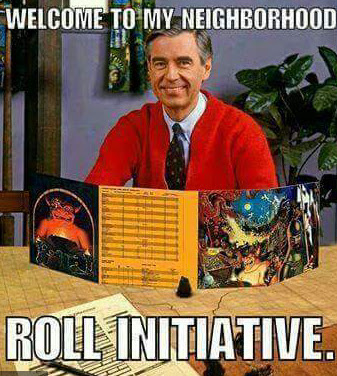
D&D: At the basis, you roll 1d20 and add your Dexterity modifier. Some Classes or Feats will allow you to add a bonus to this or your proficiency modifier in 5e. Note: In the early editions some DM’s would also have initiative rolled at the beginning of every round, not just at the beginning of the whole encounter.
Pathfinder 2e: It depends on the situation. Most of the time, initiative is determined explicitly for combat. In Pathfinder it is used in a variety of situations to give a sense of order to the actions that are taken. For combat specifically, it is a perception skill check. The idea is that the more aware you are, the faster you react to your surroundings. So, you roll 1d20 + Wisdom modifier + proficiency bonus (almost all creatures are trained in perception so you will likely always add your “proficiency bonus”) + any circumstantial modifiers that might present themselves. Environmental or physical benefits or drawbacks make the check higher or lower.
In Palladium it is a flat 1d20 roll. Those with Successful Sneak attacks or Range attacks will always have the initiative in the first round of combat.
Pretty straightforward but that may explain why the d20 system is one of the more common mechanic systems used.
Next, we will look at systems that use 2d6 as the basis for their mechanics. My examples for this are the Traveller RPG and Iron Kingdoms 2e Full Metal Fantasy.
In the Traveller RPG, you roll a Dexterity or Intelligence check. The stated reason is “it pays to be quick of hand or quick of the mind” (pg 70 Mongoose Traveller Core Rulebook ©2016). What does that mean for those not experienced with a 2d6 system or Traveller itself? Well, it is an attribute check. You simply roll the 2d6 plus any modifier you might have, positive or negative, to that roll to determine your place in the combat order. Unlike a lot of other systems, Traveller says an action is 1d6 seconds, rather than a flat 6 or 15 seconds, as in D&D and Palladium respectively.
In Iron Kingdoms, they use a 2d6 roll as well but instead of having an attribute modifier or skill directly attached to the roll, they have “Derived Stats” of which there are several. Initiative is one of these. It is made up of the sum of 3 sub-stats. Without going into too much detail about how the stats work in Iron Kingdoms (See page 105 of the “Core Rules” Book for more information ©2013), there are 3 main stats that each have 2 substats. They call the main stats “Primary Stats” and the substats, “Secondary Stats. Of those, there is one “Secondary Stat” from each of the “Primary Stats” that are added together to make “Initiative” as a whole. This is then added as a whole number, not a modifier, to the 2d6 roll. As with other systems, you may hold your “Activation”/Action until a later time in the initiative, but in this case, it actually moves your initiative to that place permanently.
And finally, we will look at a more odd rolling system as shown in the Savage Worlds RPG system. Beyond the fact that the Savage Worlds system uses a very different method for attributes and a few other features of their system, their initiative order is determined by the dealing of cards, as in a 54-card playing deck. You leave the Jokers in and everyone gets a card. Counting down from Jokers to 2s sets the initiative order and the cards are dealt every 6-second round of combat. They have a few special features for this. First, Jokers are wild; if dealt a Joker you can go anytime you wish during the round including during another person’s action. You also get a +2 to what they call “Trait test,” the most common in combat being your “attack roll” and you get a +2 to your damage rolls! So that’s a neat variable. The other special feature is that they give a mechanic if two characters get the same number or face card. You look at the suit. The ranking of the suits, from high to low, is Spades, Hearts, Diamonds, and Clubs. “Reverse alphabetical order” (Savage Worlds Explorer’s Edition Pg 60 ©2007).
I hope all of this has proved an interesting dive into how different systems handle initiative order . I also hope it has inspired you to look into all the systems and find what you like in each of them, in order to make your game better for everyone at your table, real or virtual. Thank you for coming with me on this short journey.
Game on!
About the Author
Jared “Martel” B has been GMing and playing in several TTRPG’s since late 2013. Enjoys the challenge of bringing his players worlds and stories straight from his mind in the moment that it happens. He is one of the Founders of RPGCounterpoint, happy husband to an active historian wife, and father to two puppers and newborn!
 RPG Counterpoint
Leave a comment