By Nick Stefanski
I’ve previously written about open-sourcing the planes by looking at the public domain origins of D&D’s “Great Wheel” cosmology. The outer planes can be sites for adventure locations, but they also (and originally) served primarily as homes for the gods. Deities have a mechanical function in D&D, associated primarily with the Cleric character class, but they also provide flavor for the universe in which a campaign takes place. During the early design of the game, Gygax hadn’t established any gods, and only created some (Pholtus and St. Cuthbert) when players insisted. Now, D&D sports a host of unique deities associated with its various campaign settings.
If you’re looking to quickly slot some deities into your game, the 5e SRD already provides multiple “Fantasy-Historical” pantheons for ready use. These deities are generally well known in popular culture, which provides a great starting point, but also risks limiting your setting. What if you don’t want your world organized along the heroic struggle of Norse, the stoic afterlife of Egyption, or the classical contours of Greek mythology? Why can’t I use those familiar names like Corellon and Gruumsh, and where did they come from, anyway?
You might be surprised to learn that many of the deities in Dungeons & Dragons started out as reskinned versions from real world mythologies. Gygax never explained too much of the rationale behind the Greyhawk deities, other than that they tended to be developed as needed in the game world. “The development of anything akin to a logical pantheon of deities for the world setting took a considerable period of time to complete,” He wrote, “because we seldom dealt with such entities in play.”[1] However, Ed Greenwood gave extensive detail on his development for the gods of the Forgotten Realms in a 1981 issue of Dragon Magazine, long before the Realms had even become an official campaign setting! The provenance like some deities, such as Tyr, is rather obvious, but others are less so, like the fact that Ilmater comes not from a similarly named Finnish goddess but from ‘Iseek of the Jug’ from the fiction of Fritz Leiber.[2]
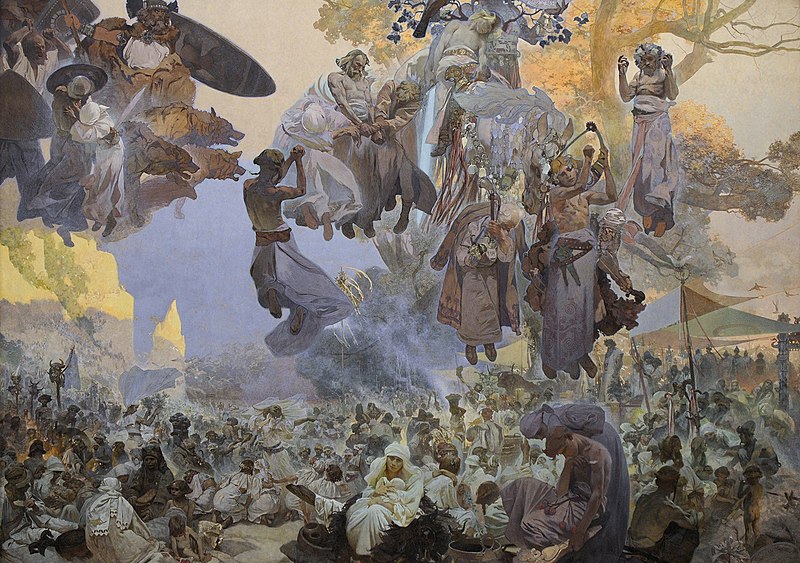
Even the Dawn War pantheon, as explained in the 5th Edition Dungeon Master’s Guide is cobbled together from a mix of real world pantheons, earlier D&D campaign worlds, and a few custom creations. This group of gods and goddesses premiered in the 4th edition, and designer James Wyatt wrote that the designers originally, “thought we could get away with creating general rules useful to clerics regardless of which pantheon existed in the campaign, and then presenting a variety of fictional and historical pantheons for DMs to adopt or adapt as they saw fit.” However, this fell out the window as they tried to actually flesh out the setting. “When we wanted to put a temple in an adventure, what god would it be dedicated to? We could make Generic Evil TemplesTM, but that would sap a lot of the flavor out of our adventures, and rob us of specific plot hooks and story lines based on the portfolios and histories of these gods.”[3] And thus, a new pantheon was born.
Real world pantheons often share similar features like sun gods and storm gods because real world mythologies generally serve the same purpose of explaining features of our world, like the movement of celestial bodies and changes of the weather. But pantheons of D&D also have specific mechanical features that they need to fill, and if you look at 4e’s Dawn War pantheon next to, say, the 3rd edition’s “default” pantheon that was itself an abridged list of Greyhawk deities, you can start to see certain patterns emerge. Before going into the origins of specific deities, it’s important to understand the core functions of a pantheon in the D&D game.
First off, the pantheon is there so that the players can have some choices when they fill in the section for “deity” on their character sheet. The emphasis here is on choice: If there is only one god for fighters, then your fighter has exactly one option, and if the fighter god is lawful while you’re chaotic, then you’re out of luck. The 3rd edition pantheon, for instance, has Lawful Good Hieroneous, Lawful Evil Hextor, Chaotic Good Kord, and Chaotic Evil Erythnul covering different aspects of war and combat with their portfolios, giving fighters plenty of viable options. This was the route that Jeff Grubb took when designing the gods of Dragonlance: “My godhead was fairly straightforward – I needed a god for good fighters, one for evil fighters, one for evil, good, and neutral mages, one for monks, etc.”[4] It’s also useful for NPCs, as Greenwood noted: “that players will not immediately know the deity (and accompanying religious restrictions) of an encountered NPC by knowing the NPC’s class (or for that matter, race or alignment).”[2]
Mechanically, deities are most important to Clerics because their portfolios influence the possible domains that a Cleric can choose, and this is their second big function. In 5e, there are eight domains in the core rules, with more offered in supplements, but these original eight do a fairly comprehensive job of covering the most common portfolios in world mythology: life, death, knowledge, trickery, nature, tempest, light, and war. As we saw, Greyhawk has war deities in the four corners of the alignment chart to support nearly any Cleric alignment; you can also go the route of the Forgotten Realms whose chief war god, Tempus, is True Neutral to be ultimately accommodating, and this is often the case for D&D deities of knowledge and nature. Some domains make more sense for certain alignments, like trickery with chaos and death with evil, but you can also shake things up here: think about what a Lawful Neutral death deity like Kelemvor or the Raven Queen says about your world versus the traditionally Neutral Evil options like Nerull and Vecna. What would a world with a prominent Neutral Good or Chaotic Neutral death deity look like?
This leads us to the third important role of a pantheon, which is creating the particular flavor of the world you’re writing. For instance, Ed Greenwood wrote that he wanted a “a vaguely Norse/Celtic/“old faerie England” flavor” for the Forgotten Realms, which meant that while he was fine directly importing deities like Tyr, Oghma, and Silvanus, deities like the Greek Aphrodite and Hephaestus received new identities in “Sune” and “Gond.” You can also look back at Dragonlance with its balanced rosters of good, neutral, and evil deities and how they represent the moral conflict inherent in that setting. Or in the Dawn War pantheon, how a prominent goddess of civilization, Erathis, develops the idea of “points of light” in the dark wilderness. For a more extreme example take Keith Baker’s Eberron, with its pantheon of distant deities. “I love mythology,” writes Baker, “I enjoyed the Iliad, and for that matter, I liked the Time of Troubles when it rolled through the Realms. But I wanted Eberron to be a place where you could tell stories that don’t make sense in a world of active gods.”[5]
Finally, as an optional fourth role, the pantheon can serve as plot drivers in a world. In this sense, deities are the ultimate high-level NPC quest givers and adversaries. In this way, they can serve a role similar to the icons of the 13th Age roleplaying game. For those unfamiliar with this game, an icon is “a powerful NPC (non-playable character) that has a strong influence on the world outside of your campaign, yet may indeed aid or oppose your character over the course of your campaign, depending on the relationship your character has with the icon.”[6] The icons are explicitly not deities, because deities are usually fairly far removed from all but the highest level characters. However, some of the icons, particularly the Great Gold Wyrm, the Lich King, and The Three are very similar to Bahamut, Vecna, and Tiamat, respectively. The icons are also useful because they again demonstrate how gods of different alignments can set up conflicts in the campaign world, with some good aligned but competing patrons, a number of evil foes advancing their own plots, and a few neutral parties that can tip the scales in either direction.
Now that we’ve established some of the functions of the deities in a campaign world, next time we will build our own open source pantheon, diving into some of the backstories of D&D deities along the way. Stay tuned!
About the Author
Nick Stefanski has been playing RPGs since the 90s and publishing them since 2020. You can find his bestselling works on DMsGuild and DriveThruRPG, or hear about new releases on his site khyberia.com. He’s also on most of the socials as @TzarFenix
[1] https://archive.org/stream/enword_gary_gygax_qa_threads/enweggqa08_djvu.txt
[2] https://archive.org/details/dragon-magazine-270/Dragon%20Magazine%20054/
[3] https://web.archive.org/web/20090601214637/http://www.wizards.com/default.asp?x=dnd/drdd/20071029
[4] https://dragonlancenexus.com/jeff-grubb-interview/, Grubb goes into more detail on the development of individual deities here: https://dragonlancenexus.com/jeff-grubb-gods-krynn/
[5] https://keith-baker.com/dragonmarks-411-religion-and-faith/
[6] https://www.13vaults.com/compendium/basic-rules/icons
 RPG Counterpoint
Leave a comment