By Nick Stefanski
The stories of mythology weave unforgettable tales; the epic Trojan War, the tragedy of Ragnarok, the mysteries of Osiris. These tales of heroes, gods, and monsters are compelling, but they don’t always work for a roleplaying game that relies on player agency. So how can we construct our own open source pantheon?
Last time, we reviewed the role of gods in D&D and similar games, two mostly mechanical and two more story oriented. Mechanically, the gods have to:
- Be relevant for as many class/race/alignment combinations as possible.
- Represent all of the core domains for clerics with a similar alignment spread.
Narratively, the gods:
- Say something about the setting.
- Set up conflicts within the world.
Since we’re not establishing a setting, we’re going to focus primarily on the mechanical functions, while also exploring the origins of D&D divinities. For structure, we’ll primarily look at the default pantheons in 3rd edition (a selection of Greyhawk deities), 4th edition (labeled the “Dawn War” pantheon in 5e and used in Critical Role), and the Forgotten Realms.
Truth, Justice, and the Celestial Way
There are a few sorts of deities that are found among the upper planes. Starting in the top left of the alignment chart, there is generally a Lawful Good deity associated with war who can be a patron of Paladins, Monks, and other martial types. In 3e, this was Heironeous, and in 4e it was Bahamut. While Bahamut’s name is drawn from real world Arabic mythology, where he is a giant fish holding up the world, it’s a bit of a far stretch from the platinum dragon. The Forgotten Realms has Tyr, who in the world’s lore is the same Tyr from Norse mythology. Not only is Tyr a pretty good pick for the Lawful Good alignment (he sacrificed his own hand so that Fenrir could be bound when no other god was willing), his journey to the realms actually kind of makes sense given that in the real world, Tyr was likely the chief sky god whose position was later supplanted by Odin and Thor. So, let’s pick Tyr for our Open Source pantheon.
On the Chaotic Good side, 3e gives us Kord, a good pick for noble barbarians and other martial characters who like to break the rules. Kord bears some resemblance to Norse Thor in his Greyhawk incarnation, and this became more pronounced in 4e’s Dawn War version, whose alignment also shifted to Chaotic Neutral. The Forgotten Realms is kind of lax on CG warrior deities: there is Valkur who I honestly never heard of until looking him up for this article, and though Tempus vacillates between CN and True Neutral in different editions. Having some sort of storm deity in this section ensures that good clerics (but not necessarily lawful ones) can choose the tempest domain: you could always just use Zeus, or someone less well known, like the Albanian Zojz.
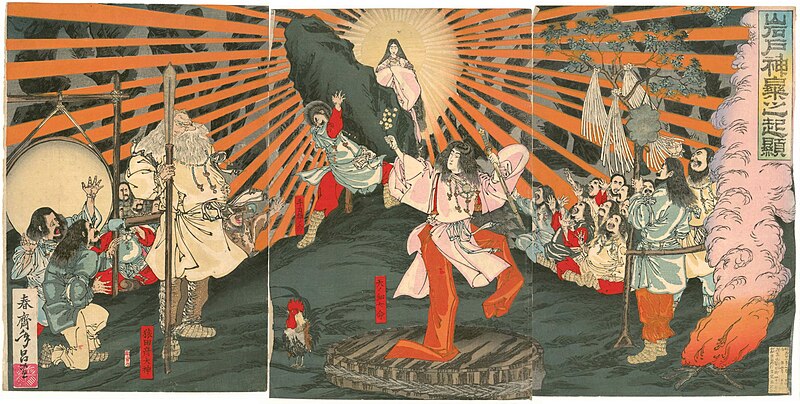
The most important Neutral Good god is usually a solar deity. This makes sense from a historical perspective, given the importance of the sun in real world mythology, and it also offers a pretty generic option that all good aligned characters can choose in a pinch. What’s more, the sun fits thematically with healing as well as flaming pillars, both mainstays of the Cleric’s spell list. Both 3e and 4e have Pelor (the Burning Hate notwithstanding…) while the Forgotten Realms has Lathander who, though he has no listed origin, seems pretty close to Apollo. Of course, like storm gods, sun gods are fairly common. As anyone who has played Okami, I am partial to the Japanese Amaterasu.
Nonhuman Deities
Throughout the official pantheons, you’ll find the same group of nonhuman deities: Corellon, Moradin, and Gruumsh are the most ubiquitous, but there are others. These deities were actually created specifically for Dungeons & Dragons. Most of the major ones were introduced in the original Deities & Demigods, though they had originally been created by Lawrence Schick in his home campaign with Tom Moldvay that would eventually become the Mystara setting. “In each case – and this applied to all the nonhuman deities – I wanted the humanoid gods to be the epitomes of what those races represented,” said Schick. “So it was really just a matter of analyzing what each race stood for in D&D terms, and then creating a larger-than-life figure who embodied those qualities. I gave Gruumsh a single eye so he’d be visually interesting, more than just a really big Orc. The inveterate hatred between Gruumsh and Corellon Larethian – and their worshipers – wasn’t mentioned in Deities & Demigods, and was added by later writer/designers. Good idea, though – I approve.”
In many ways, then, the core nonhuman deities are sort of the stereotypical, idealized versions of their races. Gruumsh is a fearsome warrior who craves battle. Corellon is powerful, graceful, and androgynous. Moradin has a hammer and likes to craft stuff. In this sense, you could easily swap in 13th Ages’ nonhuman icons for these, supplying your own names as needed. These races mostly come to D&D from Norse mythology via Tolkien, so you could also raid those sources for interesting names (not Tolkien, though, his works are not in the public domain). I am partial to Titania for elves/fey and Völundr for dwarves, and for orcs… I dunno, Orcus?
Maintaining the Balance
The neutral deities often represent vast, impersonal forces. Chief among these is nature, which very often is True Neutral to match the default Druid alignment. 3e’s Obad-Hai is the standard green man of folklore, so is the Forgotten Realms’ Silvanus, straight out of the Celtic pantheon. 4e’s Melora, meanwhile, is of uncertain origin. The DMG lists her as an original creation, though the name literally comes from Greek for “Golden apple,” possibly from Eris, goddess of discord. 3e also has a secondary good nature goddess in Ehlonna (no stated origin, but for a unicorn goddess it’s suspiciously similar to the Celtic Epona), who has a Realms counterpart in the Finnish transplant Mielikki.
Because it’s D&D, there has to be at least one deity of magic for the wizards. In 3e this is the True Neutral Boccob, but 4e has a new deity, Ioun, named for the magic items which got their name from a Jack Vance story. The Realms split the difference three ways with Lawful Neutral Azuth, True Neutral Oghma (from Celtic mythology), and Mystra who was originally Lawful Neutral but is now Neutral Good. Mystra is one of the most famous deities of the Forgotten Realms, or D&D in general. While Greenwood didn’t state an inspiration for her, he did mention that the Assyrian deity Ishtar was one of his favorites that he didn’t want to directly use based on the setting’s flavor. Ishtar is a love goddess, but is often syncretized with the Egyptian Isis, who also has magic in her portfolio.
The Chaotic Neutral alignment also needs a major deity, and it’s often one that can accommodate Rogues and roguish types like 3e’s Olidammara or the Forgotten Realms’ Mask. Even the 13th age has the Prince of Shadows, but this role is strangely absent in the Dawn War pantheon. The closest they have is the Chaotic Good Avandra, based on the Forgotten Realms’ Tymora, herself an amalgamation of Greek Tyche and Egyptian Bes. Mask is based on Hermes, but you could pick any number of trickster gods or culture heroes: how about Anansi?
The neutral alignments (usually Lawful Neutral) often get a deity whose domain is death in order to avoid it becoming the exclusive province of evil. 3e has Wee Jas (who doubles as a goddess of magic), the Realms have Kelemvor, and the Dawn War pantheon has the Raven Queen. The DMG list her influences as Wee Jas and Norse Hel, but given her major motif, there’s likely at least a bit of the Celtic Morrigan.
The Forces of Evil
Evil deities are usually there less as player options, but in order for there to be a wide variety of evil cults for the heroes to thwart. Still, these deities tend to encompass the whole spectrum of evil. Lawful Evil is the alignment of tyrants. 3e had Hextor, who didn’t make sense without his good counterpart Heironeous, so 4e replaced him with Bane. This Bane is canonically different from the Bane of the Forgotten Realms: essentially, the designers wanted a Bane-like deity but couldn’t think of a better name, so Bane stuck. 4e Bane is based on pop culture depictions of Ares, but Ed Greenwood’s version was based on a deity listed in Deities & Demigods called Druaga. There is no real deity of this name, and most likely the deity was interpreted from the concept of Druj or “deceit” from Zoroastrianism. Still a good name, though. Also of note, Bane in the Realms has two associated deities Loviatar and Kiputytto from Finnish mythology, though the latter got renamed Talona.
There has to be a Neutral Evil god of death. 3e has Nerull, the Forgotten Realms have Myrkul, but the most famous has to be Vecna. I mean, what other deity got name dropped in a Netflix show? Vecna is an original D&D creation, and the entity came after the artifacts that bore his name. Vecna is the ultimate lich, and though liches also have varied origins, one of the major ones is the figure of Koshchei the Deathless from Slavic folklore, who might do for an evil mastermind in a pinch.
There’s also at least one (but usually more) exemplar of the Chaotic Evil alignment who wants to completely undo creation. Though he wasn’t listed among the default 3e pantheon, Tharizdun is from the Greyhawk setting. His reputation is great enough that he made it into the Dawn War pantheon, and even seems to moonlight in the Forgotten Realms now. He might be based on Thasaidon from the works of Clark Ashton Smith, dating back to 1934. This means that Thasaidon is due to enter the Public Domain in the year 2030, and in the meantime you can search through the extended Cthulhu mythos for other suitable candidates. You could look at Lovecraftian predecessors like Chamber’s The King in Yellow or one of Dunsany’s Gods of Pegāna. Or, you could take a chaotic destroyer from Robert E. Howard’s contemporaneous Conan novels, the Dawn War’s Zehir who is actually just Set with a new name.
We can’t talk about evil D&D deities without at least mentioning Tiamat, of various evil alignments. The mother of evil dragons takes her name from the Babylonian mother of monsters, which I would consider close enough to put her in the public domain, unlike a draconic Bahamut. That being said, you might want to avoid giving her five heads, as that might steer too far into specific product identity.
Miscellany
That covers most of the major deities from D&D’s various core pantheons, and I feel that we’ve now assembled a decent starting point for an open source pantheon. You can tailor it to your own campaign world, but don’t forget to also listen to your players!
One of Jeff Grubb’s players worshiped only money, so Grubb made his deity the Walking Liberty Half Dollar, which eventually got shortened to none other than Waukeen in the Forgotten Realms pantheon. For more recent examples, you can look at how Critical Role added Raei (from Pathfinder!) and the Traveller to the Dawn War pantheon in order to accommodate party Clerics. Pantheons can flesh out your campaign world, but that world is there for the players to interact with. Work with them, and you can find your world going in wonderfully unexpected directions.
About the Author
Nick Stefanski has been playing RPGs since the 90s and publishing them since 2020. You can find his bestselling works on DMsGuild and DriveThruRPG, or hear about new releases on his site khyberia.com. He’s also on most of the socials as @TzarFenix
 RPG Counterpoint
Leave a comment