( a trip in learning to let go of the crunch and embracing the action)
Written by: Trip
I, like many of you I’m sure, got started in the TTRPG scene with good ol’ D&D (5e, to be exact.) And like every new player, I fumbled around a bit while I was still learning how to play. But as soon as the rules “clicked” in my mind, it was like I’d unlocked an entire universe of possibilities! I think I almost immediately started writing my own campaign and designing my own Homebrew. I was hooked. I was obsessed! Surely nothing could be better than this?
Oh boy, was I in for a shock when I dipped my toes into Powered By the Apocalypse (more on that later.)
A couple online friends were looking for players in a game called “Fellowship”. I’d never played anything outside of D&D, but I was willing to learn. I wanted to play with these people. And really, how different could it be?
My dear readers, it was VERY different.
What is “Powered By The Apocalypse”?
For the uninitiated, Powered By The Apocalypse (PBtA) is a sort of “engine” that several TTRPGs are built from. It uses a base 2d6 system rather than a D20, and it focuses a lot-less on combat and far-more on the other pillars of play. There are many PBtA games out there, including Monster of the Week and the game we will be focusing on today: Fellowship.
Fellowship is built for more-cinematic, Heroic action where you play as a group of heroes trying to defeat the “Overlord” played by the GM. Everyone–including the GM–had to follow certain guidelines whilst building and playing their character. For example: the Fellowship all had to be heroic individuals who wanted to save the world by stopping the Overlord, So no Murder Hobos or cowardly loot goblins allowed. And the Overlord was also bound by certain tenets, selected from a list of a half-dozen or so motivations and then tailored to the campaign.
You also had to have “Bonds” with your fellow party members, as well as with the Overlord! A Bond is basically something that ties you to that person in some way. But this wasn’t just some kind of fluff mechanic for roleplay purposes. There were actual mechanical benefits AND downsides to having Bonds. For example, if the Overlord has a Bond with you, they can break one of those Bonds to cause you to automatically fail a roll.
I could go on and on about the mechanical differences between Fellowship and D&D, but we’d be here all week. 😅 Suffice to say, the differences were staggering and, honestly, a little overwhelming. Coming from a game where basically all of your abilities were centered around combat, I was very confused at how most of the “Moves” in this game worked.
- “What is an Advantage? How do I know if I have that so I can roll to Finish Them in combat?
- “Is there a specific criteria that needs to be met before I can make or break a Bond?”
- “My weapon has the Ranged tag, but it doesn’t say how long that range is?”
- “This Playbook has a feature that lets me… Open doors of any size? Is that any good?”
- “What does the Useful tag even do? Like, can it just do ANYTHING so long as I would consider that effect to be Useful to my current situation!?” (spoiler alert: that’s exactly what it means. More on that later.)
Up until this point, my only experience with TTRPGs was with “crunchy” games, so going from that to a system that was a bit more-loose was going to be a serious adjustment. It had me questioning every assumption I’d ever made about Tabletop games.
When it came time for our first session, I was still very shaky about my grasp on the rules, but I trusted the others to help me pick it up as we played.
Meet the Fellowship
I’m gonna go through as quickly as I can and explain the cast and setting a bit, as it’s relevant to some stuff that comes later.
First of all, the setting was a Sci-Fan setting which we all collectively helped create and develop over the course of the campaign. All of us were amateur writers of one type or another, so things got pretty interesting (and a little crazy) as the campaign stretched on. We had a galactic Republic to oppose the Evil Empire (every Space setting needs one); a race of Dragon Spirits that have watched over humanity for eons; 6 distinct races of Elves; a city where the fabric of Timespace had weakened, allowing us to time-travel in that location; and across the whole galaxy sentient races of all shapes and sizes started developing X-men-like superpowers, which we called “Metas” and which serves as the foundation for galactic arms race.
My character was an Elf named Tor Meldilorn (fans of C.S. Lewis may recognize that name as being derived from his oft-underrated Space Trilogy, which I used as the foundation for my corner of the galaxy.) I also had a Companion named Gideon who acted as my apprentice and also the comic relief of the group. Which meant I got to roleplay both ends of the serious/silly spectrum. It was super fun.
Another Player played Chloe Hakawa using the Harbinger Playbook (kinda like a Wizard) which we reflavored as a Meta with Psionic powers. She was also one of the best generals in the Republic’s military. Think Jean Grey with lasers and military training.
And last but certainly not least was Sesseri the Dragon. A member of the aforementioned dragon spirits who has come to aid the Fellowship because the dragon god in charge of maintaining the proper flow of time and space had recently gone missing. Which, as you can imagine, is a pretty big deal.
The moment it finally clicked
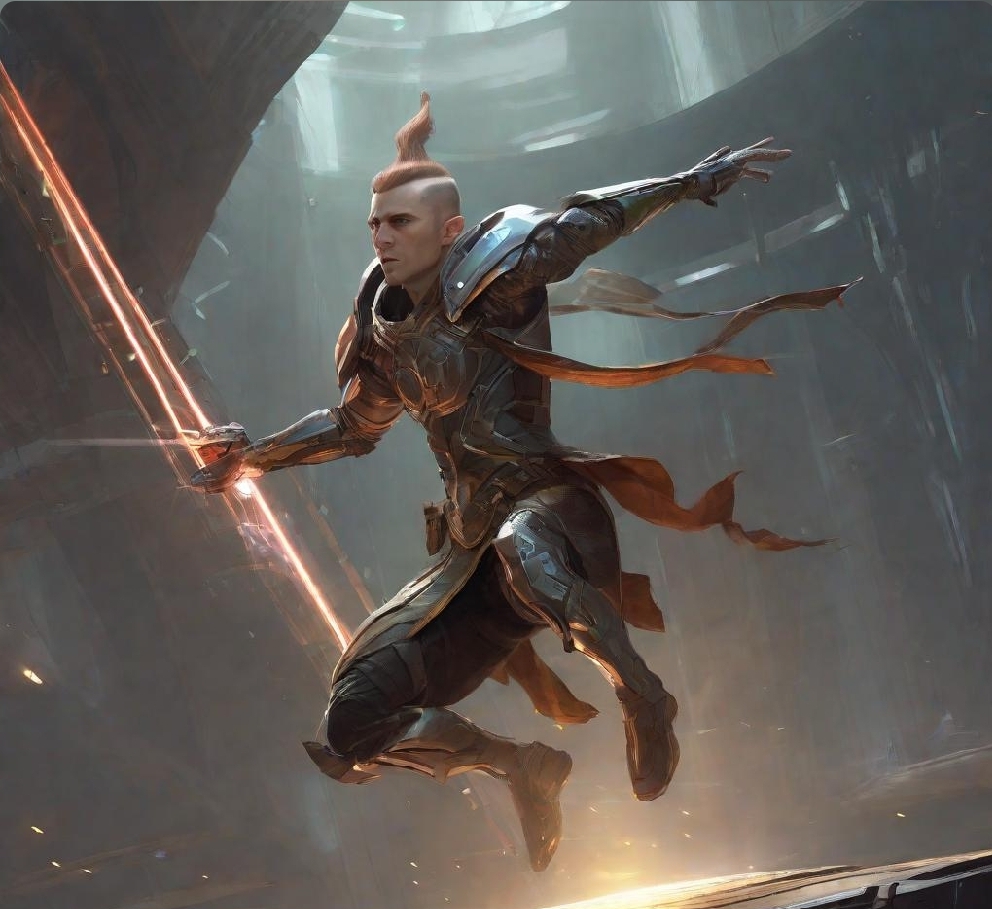
In the first session, we were tasked with infiltrating and investigating a believed-to-be-abandoned space station that was held by the empire in a previous war. We suspected Calliope–the leader of the Dark Elves and ally to the Overlord–had recently stopped there and we wanted to know why. We expected minor resistance from the station’s automated defenses, and that’s exactly what we got: Robots, turrets, and the like. Despite Fellowship not actually having damage values, Sesseri and Chloe were definitely heavier hitters than me, so being the tactical-minded player I was, I mostly just set them up for flashy finishers and helped provide support with my various gadgets and healing ability. It was going pretty well.
Eventually I was able to use my Invisibility (cloaking device) to infiltrate into the control room while the others stayed back. My intention was to see if I could deactivate the automated defenses remotely.
BANG!
A Dark Elf assassin shot me in the leg! My cloaking was down, and my Grace (my best Stat) was now damaged. Sesseri and Chloe quickly rushed to my side and the assassin leapt over the ledge of the balcony, which plummeted down a long, long way before opening up into the loading dock.
She was getting away!
But reinforcements were coming, and the old adage “Don’t split the party” came to mind. Plus I was already hurt. The tactical decision would be to let her go and help the rest of my party fight off the oncoming robots.
But this wasn’t D&D, I told myself. We weren’t here for tactical combat.
We were here for the action.
For the drama.
For the adventure!
I jump down after the assassin.
And there it was. That one decision forever changed my perspective. It all made sense now.
We both fell several thousand feet probably, fighting all the way down. Landing wasn’t an issue; in this high-tech setting, everyone had a jetpack or some equivalent. We both touched down and I used my cloaking device again. Now, I knew that she could see through my cloaking, but that was exactly the advantage I was counting on. I approached her in such a way that made her believe that I thought I was undetected, and when she went in for the kill, I dodged at the last moment and flung my Dagger straight into her skull! Victory!
Ohhhhhhh but I wasn’t done yet.
The ship she was trying to board was about to take off with precious cargo for the Empire. Now, as part of my character’s Gear, I have 2 “High-tech Gizmos” which have the Useful tag. I was told that, what that basically means is, anytime I have a problem that could be solved by futuristic technology that I might reasonably carry on my person, I can spend a Gizmo to have that tech on me.
“Can I turn one of my Gizmos into a tracking device and throw it on the ship?”
GM: “You most certainly can!”
Victory #2!
But wait, there’s more!
I finally made my way back up to the control room just as the fighting had stopped. Chloe, Sesseri, and Gideon had all made short work of the robots. But there was a problem: One of them managed to trigger the self-destruct protocol and the whole station was going to explode very shortly! We had better get going if we want to make it out alive!
“Can I throw my one remaining Gizmo at the power core to shut down the self-destruct sequence?”
GM: “That’ll do it!”
Victory #3!
To this day, I still fondly remember that campaign as the best campaign I’d ever played. We all had so much fun that after the campaign ended we started a Monster Of The Week campaign (another PBtA game). I might have a few stories about that campaign in a later blog entry.
As of writing this (December 2023) I haven’t played with that group in a couple years now, and I miss it terribly. My IRL game group prefers D&D. I do still love D&D, don’t get me wrong. And ever since broadening my horizons, I try to be a little more flexible in my games when I think it will lead to interesting action.
TL:DR, go play PBtA. Maybe it’ll help you learn to embrace the fun of TTRPGs in a new way?
About the Author:
My name is Trip and game design is my passion. I started out with D&D about 10 years ago, but have played a few other systems like Fellowship and Monster of the Week. I’ve even tried my hand at designing my own TTRPG a few times (maybe one of these days I’ll actually finish one?) I love both playing and running games, but I also love the oft-overlooked joy of learning new game systems. It always sparks my imagination seeing a new take on mechanics and rules, and I’m always excited to test the boundaries of those rules to see if they work as-intended and whether they can be improved upon. And who knows? Maybe someday I’ll successfully create my own game and become a household name in the TTRPG sphere? A boy can dream. 😅
 RPG Counterpoint
Leave a comment