
By: Max Sirak (of Peak DnD) and Dave Blake
In the narrow side streets of Kagrinn City, Porsup the dwarf slides silently along the grimy stone wall. Taking care to avoid the detritus littering the ground, he approaches the mouth of a nondescript alley. A quick glance tells him that the alley is a dead end, terminating after only fifty feet at a blank wooden door. A single lamp above the door illuminates the head and shoulders of an armed guard lounging against the wall.
Grinning to himself, Porsup draws a long cloak around his shoulders and pulls up the hood, expertly concealing his face and body in shadow. Disguise in place, he steps into view with purposeful strides.
The guard’s head comes up, revealing the delicate features of an elven woman. Her hard eyes narrow. “Wrong way, pal,” she growls and spits into a cracked bucket on the ground.
Porsup slows, but does not stop. With a gloved hand, he makes a complicated gesture in the air before him.
The guard stands up straight as he comes closer, drawing her sword partway from its scabbard, just enough to expose a few inches of sharpened steel. Flecks of gold decorate the metal, glittering in the lantern light.
He halts his approach a few feet from the immobile woman. “No, I do believe I have the right place,” he says in a squeaky falsetto, making the sign again with his hand. “As you can see, I am also a member of the infamous guild of female assassins: The Gilded Grace Blades,” he trills harshly.
“She’s not buying it.”
“Seriously, she beat a 28 deception roll? I even did the secret wave thing. You said it was possible.”
“I said it might be possible. But I also said you’d need more than just a cloak and a high-pitched voice to fool her into thinking that a heavily bearded dwarf is an elven lady-assassin. She fully draws her sword.”
“Ugh, fine.”
As the guard’s sword slides free of its scabbard and points at his throat, Porsup holds up his open hands between them. “Okay, okay. You got me. I’m actually– BY THE BEARD OF ABBATHOR, what is that?!” He cries, pointing frantically into the air above them.
Reflexively, the guard’s eyes flick skyward for a fraction of a second. When she looks back down the cloaked figure has vanished.
“Yes! Nat twenty for stealth!”
“No. That doesn’t happen.”
“What? The book says that as long as nobody’s looking at me, I can hide in shadows.”
“It doesn’t mean you instantly turn invisible! What are you going to do, jump in the bucket?”
“But it’s a critical success!”

As TTRPGs become more accessible and video games become more sophisticated, the dividing line between them keeps getting thinner. Many of the most popular TTRPGs now have video game adaptations. One of the consequences of this is that both GMs and players can sometimes slip into “video game mode” at the game table. Battle maps and minis stop being representations of a dynamic world, and start becoming viewed as a game UI. Character sheets become lists of items and abilities, instead of descriptions of a hero. This can quickly get frustrating when most of the table is trying to interact with NPCs and develop their characters’ stories, meanwhile, one or two players are only trying to button-mash their way to victory.
Dave: As a DM, one of the general rules I try to stick to is that if I can’t visualize it happening in “reality”, it doesn’t work. If a player can describe what they’re doing in a way that makes it seem plausible, I’ll give them a reasonable chance of success. But if all they can come up with is, “I activate my ability,” it’s not going to sway me.
Max: And I am instantly transported back in time to when Phil was trying to convince you that his flying force-Tardis (a mobile, invisible, personal force cube) was “totally reasonable.” I’m also reminded of having to show my work in middle school math. (Max)
Video games don’t force us to show our work. We don’t have to come up with how pressing A, to roll a deception check, actually allows us to get past the guards at the gate. We just press A and it works or it doesn’t.
Around the table is different. Here we are on the hook to come up with plausible explanations and plans of why pressing A works.
When players start trying to video game:
Skills & abilities
The player treats their character’s skills and abilities like status effects and expects to be able to turn them on and off like a switch.
Dave: This is one that I encounter a lot in various forms. A player wants to use their haggling skill, which is meant to represent more aptitude for negotiating, but gets frustrated when I describe the merchant as intractable or contentious, instead of just automatically knocking off 10% of the total cost. Or they want to use their trip ability on an opponent and I have to explain why they can’t actually leg-sweep a giant slug.
Max: Buuuuut Daaaaave – it says I can use my bonus action to make a trip attack on any enemy I’m adjacent to, not that the enemy has to be standing. Or have legs.
Inventory slots
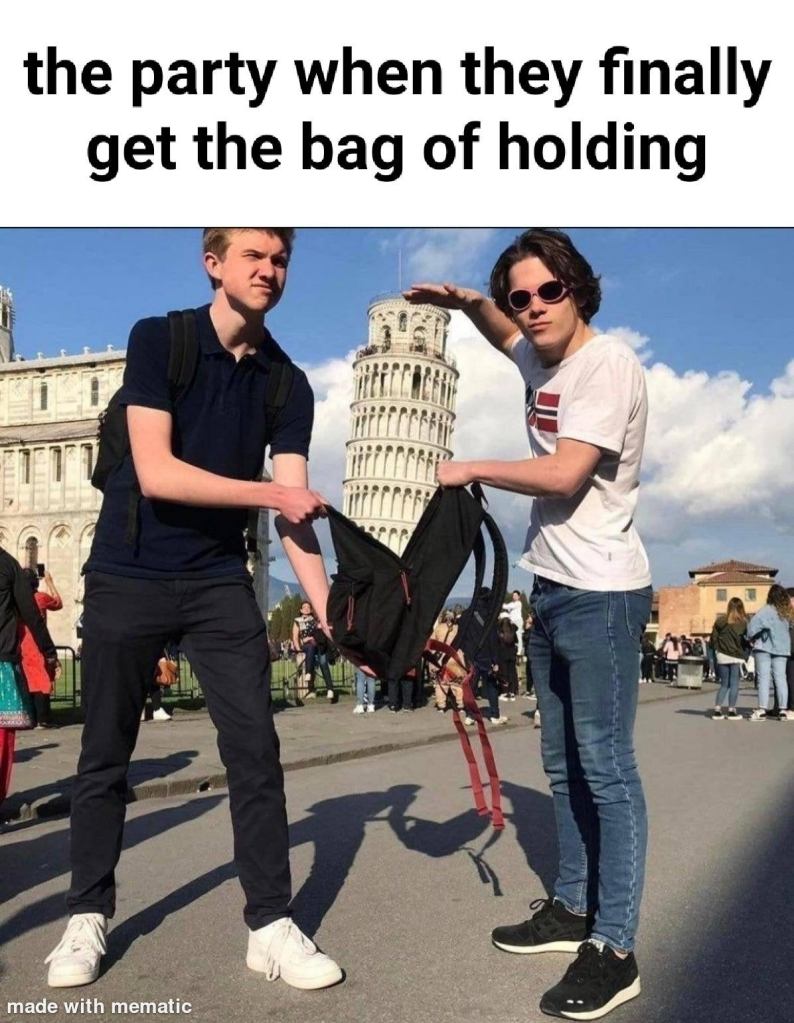
Most players and GMs don’t enjoy mapping out exactly where a seasoned adventurer keeps their arsenal of weapons, ammunition, supplies, and loot on their person. Taking the weight of each individual item into account for encumbrance also quickly becomes tedious.
Dave: I try to think of inventory as more than just entries on a list, and can vaguely picture golf-style bags of swords and maces, bandoleers of potion vials, and all manner of pockets, belt pouches, and fanny packs. But there have been times when players tried to over-prepare by loading up their travel packs with ladders and rowboats, or when they tried to haul away every idol and antique in a defeated vampire’s keep. That’s when I draw the line and suggest carts, pack mules or even porters.
Max: One of my favorites is the 10-foot pole. Or a ladder. Seriously. Have you ever tried to maneuver a ladder up a flight of stairs? Can you even imagine what it would be like to haul one through a narrow dungeon with low ceilings?
Rest periods and cool-downs
These are some of the bigger hand-waves in RPGs in general. There are all kinds of things that are assumed to have happened during downtime like weapon and gear maintenance, practicing and studying skills that a character hasn’t used recently to keep from getting rusty, and simple leisure to keep from burning out. A cool-down period is meant to represent all of the various reasons that a person or item can’t do that same extraordinary thing over and over continuously.
Dave: It always nettles me a bit, when players insist on a full eight-hour rest after every skirmish. I understand wanting to get back those spells and abilities you used, but seriously guys, you just woke up and broke camp two hours ago. Plus, monsters will wander, guards will change shifts, scouts report in… the rest of the world isn’t just going to pause while you hang out for half the day.
Max: It’s also heartily unrealistic, which I appreciate is maybe the wrong word, given the elf and robot games we’re talking about. But still. What level of exertion, what type of “thing” must a person do that takes two hours and expends enough energy that they immediately want to go back to sleep?
When GMs start trying to video game:
Dialogue options
Lots of RPG video games have decision trees and dialogue options. Choose to be conciliatory or act like a jerk, reveal or conceal information, etc. These choices can greatly influence NPC allies’ and enemies’ attitudes toward the protagonist.
Max: Totally! Sometimes the merchant you’re trying to haggle with didn’t poop this morning and is in a crummy mood. It doesn’t mean they hate you and are now your forever-enemy, just that they didn’t eat their greens.
Dave: I like to think I avoid this one and play NPCs more like people than dialogue trees. But I’ve definitely made an NPC repeat themselves if the players don’t pick up an important detail the first time around.
That’s what the book says
Sometimes players can come up with creative solutions to problems, but get shot down because it’s outside what the published adventure accounted for. The DM reads through the descriptive text and shrugs; “Sorry, that’s all it says.” They’re unwilling or unable to expand the narrative beyond what’s written.

Max: This is the maddening equivalent of when your parents used to end disagreements with, “Because.” Look – just because you and all the folks who wrote the adventure didn’t account for the accumulated awesomeness of your co-players’ imaginations doesn’t mean it should flat-out not work.
Dave: Sometimes I do get caught off-guard when a player throws out a non-sequitur and declares that instead of fighting their way into the tower and up stairs, they’re going to silently climb the tower exterior instead. Heroes are often clever like that though.
Ask the right question
The player tries everything they can think of, but they haven’t tried that one specific action that will solve the problem. The DM shakes his head at every suggestion as if they’re working their way through a list of possible actions and he’s waiting for them to select the correct one.
Max: Especially when there are no bones to be thrown. Sometimes there is a vital piece of information that only one person in the kingdom knows. I get it. And also – everyone playing the game has a lot more fun when the clerk says, “Yes…I do recall Alobar mentioning something like that…” instead of “No.”
Dave: Admittedly, this is one that I still do sometimes. I dislike narrating a player’s actions to them, and it’s more fun if they find the solution to a problem on their own. But of course it’s obvious to me that the blue key opens the blue door. In reality, nobody remembers finding a blue key in that treasure chest two months ago, and whoever wrote it down in the loot list didn’t even note that it was blue anyway. It just feels so anticlimactic to ask, “Hey… remember that innocuous key you found that didn’t seem to fit anything at the time? The blue one?”
In the End
TTRPGs are supposed to be fun. For everyone. That means for the person next to you at the table who wants to kick each and every door down – and – for the GM with the carefully woven narrative of political intrigue. The trick is striking the right balance for your group.
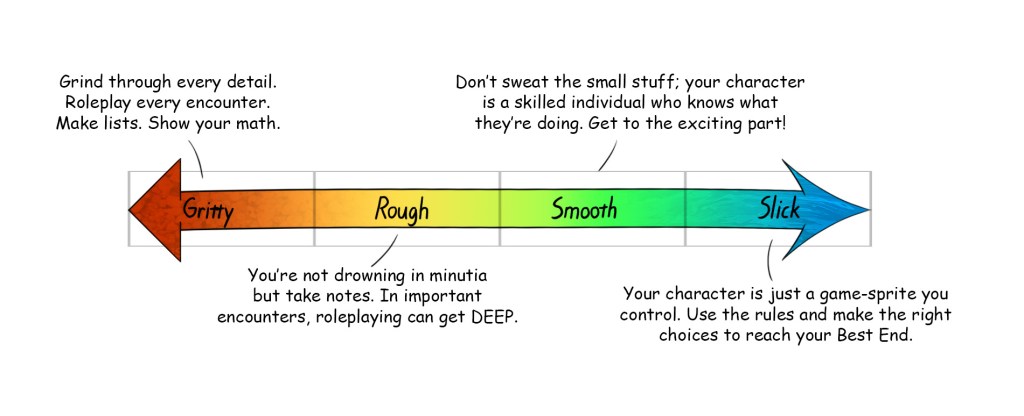
To help with that, Dave whipped up a handy Grit-Graph (name pending). Take a peek down below. See where your tastes happen to fall. Are you like Porsup, perhaps, and prefer it slick? Or do you like it as gritty as can be?
Dave and Max have been friends and playing games together since two years before Avatar came out on Nickelodeon.
About the Authors
Dave has been an avid TTRPG player and DM for the better part of his life. There are few things in life that give him more joy than sitting around a table with several friends, just being creative at each other for hours on end.
Max is part of PeakD&D. You can find him and his friends on YouTube making stuff to help people have more fun in Dungeons and Dragons and life. And you can expect more stuff like this, here at RPG Counterpoint, in the future.
 RPG Counterpoint
Leave a comment