Written By: Joe Gaylord (Lazarus Game Lab)
Alignment is one of the most hotly debated aspects of Dungeons and Dragons. There are those who want to see it removed completely from the game as an outdated and problematic concept. There are others who see it as an iconic element that helps define the fantasy genre. The debate has found its way into official D&D content, where alignment has been slowly reducing its prominence with each edition and iteration of the game. The role of alignment has gone from requiring specific classes to align their behavior, to a specific alignment to where devils and demons, literal embodiments of evil, are now described as “usual” evil. Maybe there’s a better way forward. Maybe the right answer is staring many nerds right in the face.

Both sides have good arguments.
Those who want to keep alignment in the game see it as the most iconic element of the hobby besides polyhedral dice. The classic 3-by-3 alignment chart shows up in meme templates and it has defined the worldbuilding and lore of D&D, from the structure of the great wheel cosmology to the blood war. Battles of good and evil define the fantasy genre, and alignment provides an easier starting place for players and DMs. Heroes are good, villains are evil, good beings take moral actions, evil creatures take immoral ones. It all fits on a simple matrix that provides straightforward answers. Finally, for a lot of players, it’s more fun; not everything needs to be deeply unpacked and analyzed. Having good heroes and evil villains (or vice versa) is an enjoyable kind of escapism.
On the other hand, those who want to remove alignment see it as an artifact that needs to be left aside. The presence of evil races mirrors real world racism and xenophobia, creating an “other” who can be fought and killed without consideration. The notion of evil as an absolute takes agency and nuance away from players; complex choices feel restricted or dictated by alignment. All of that without considering the fundamental question of what good and evil really mean. Famously, one person’s freedom fighter is another person’s terrorist. It depends on one’s perspective on events and one’s definition of good, evil, law, and chaos. Reducing that to a simple pair of letters on a sheet does a disservice to the narrative of a storytelling game.
I would suggest, though, that there’s a better answer than keeping or dropping alignment entirely as a concept: Color.
Another hobby exists alongside D&D and it has an alignment system that might just fix a lot of the problems. Magic: The Gathering is a trading card game created by Wizards of the Coast, the same company behind D&D. It’s actually the origin of the Ravnica, Theros, and Strixhaven campaign settings. One key aspect of the game is color identity, defining a set of 5 colors, (white, blue, black, red, and green) and their various combinations that populate the worlds of the game with ideologies and factions.
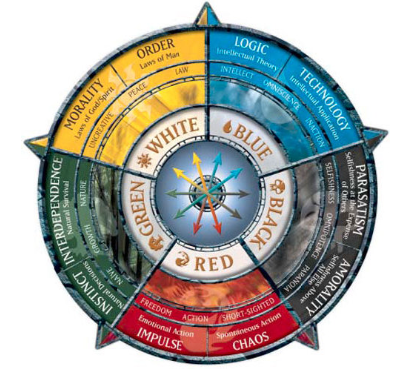
Each color has a clear mindset which has elements that blend good, evil, law, and chaos in a way that is more flexible and open to interpretation than traditional alignment.
White is the color of law and order, of the common good, but also rigid legalism. It’s the color of holy clerics, xenophobic warlords, and freedom fighters.
Blue is the color of knowledge, curiosity, and logic, the color of control, manipulation, and stasis. It’s associated with scheming bureaucrats, clever rogues, and wise scholars.
Black is the color of individualism and sacrifice, of doing what is necessary, regardless of morality. It’s the color of necromancers, delvers into dangerous secrets, and ambitious cads.
Red is the color of passion, chaos, and destruction, freedom and fearless action. It’s the color of raiders, barbarians, anarchists, artists, and gamblers.
Green is the color of nature, both of balance, and predation. It’s also the color of community, growth, and protection. It’s the color of druids, innkeepers, and hunters.
Finally, colorless represents a “hidden” sixth color. It traditionally included a mix of inanimate nature and machines and didn’t have ideology, just utility, which could be used by any color for any purpose. However, more recent design has also placed a number of ancient and eldritch beings in colorless, giving the color an ideology, one based on alien forces, rather than a moral outlook which would be comprehensible to mortal minds.
The colors also exist in an array of combinations. As examples, white and black often represent religious authorities that demand or exploit sacrifices for power; while green, blue, and black together represent knowledge that delves deeply into the forbidden and the natural world for personal power and wealth.
Between the colors, there are natural oppositions and alliances. If you think of the colors in a circle of white, blue, black, red, and green, the adjacent colors are typically allies and the opposite colors are typically enemies. So white is allied to blue and green for their focus on rules and community respectively, and enemies to red and black for their amorality and chaos respectively. These aren’t absolute, white and black and certainly find common ground in esoteric religious orders, as described above, and white’s love of civilization could lead to a conflict with green’s focus on wild nature, but they suggest the most natural lines of conflict.
All of this creates an alignment system with less baggage and more nuance than “good and evil” or “law and chaos”. Characters and creatures could use color alignments in place of the traditional axis. Instead of being usually chaotic evil, goblins would default to red, instead of lawful neutral, an elven mage might be white blue.
This would solve many of the problems with traditional alignment.
Colors don’t have the same moral judgments placed on them, all are capable of good and evil. Even with the easiest pair to map to traditional good and evil or law and chaos alignment, white and black, and blue and red, there is nuance. A lawful evil warlord building a militaristic kingdom could be white red. A chaotic good rogue thief looking to get rich and unravel mysteries could be blue black.
Even with the added nuance, there is a clear connection between color and behavior. In fact, this guidance is more closely tied to motivations and methods, rather than reflecting moral judgments like traditional alignment. A red rebel and a green rebel character might both be “chaotic good” but one would focus on a war of liberation and the other on dropping out and building up a community in the wilderness.
Worldbuilding is even better supported with color than traditional alignment. Many classic creatures, elves, goblins, demons have typical color associations which are great shorthand, but which stay flexible. Moreover, it’s less problematic to label a region or group as a color or color combination than simply calling them evil or lawful. Moreover, the enemy and allied colors create conflicts that feel as epic as wars of good and evil, but that feel less reductive, with more space for shifting alliances and loyalties, because of the step away from ideas of monolithic good and evil.
Replacing alignment with color reshapes D&D in ways that step away from its most problematic legacies, and yet maintain some of the trope-y elements that made the game what it is. They keep guardrails and shorthand in place, especially for beginners, yet allow for nuance and flexibility in ways that feel natural, all without moral judgment on complex motivations. Even better, as the D&D and Magic brands align more and more, with Magic having D&D crossover sets and D&D having setting books based on Magic planes, the use of color instead of alignment makes that crossover so much simpler, and allows the easy conversion of Magic storylines into D&D campaigns.
About the Author
Joseph Gaylord has been playing TTRPGs and TCGs for 25 years, with almost 50 titles to his name on DMsGuild as an author, coauthor or contributor, including Gathering: The Realms, a guide to adding Magic: The Gathering elements to a D&D campaign. He is on most social media as LabLazarus.

 RPG Counterpoint
Leave a comment