By: Joe Gaylord (Lazarus Game Lab)
A few years ago, I noticed a trend of grimdark RPGs gaining popularity. Gritty realism, dark themes, antiheroes, and the rest seemed to be the order of the day. They’re undeniably fun. Mork Borg, OSR, The Witcher, and all the rest are supremely entertaining and fill an obvious niche in the hobby. Yet, at the height of the trend, I got tired of it. I didn’t want to roleplay in a world that was heavy and dark and gritty. I wanted something more hopeful.
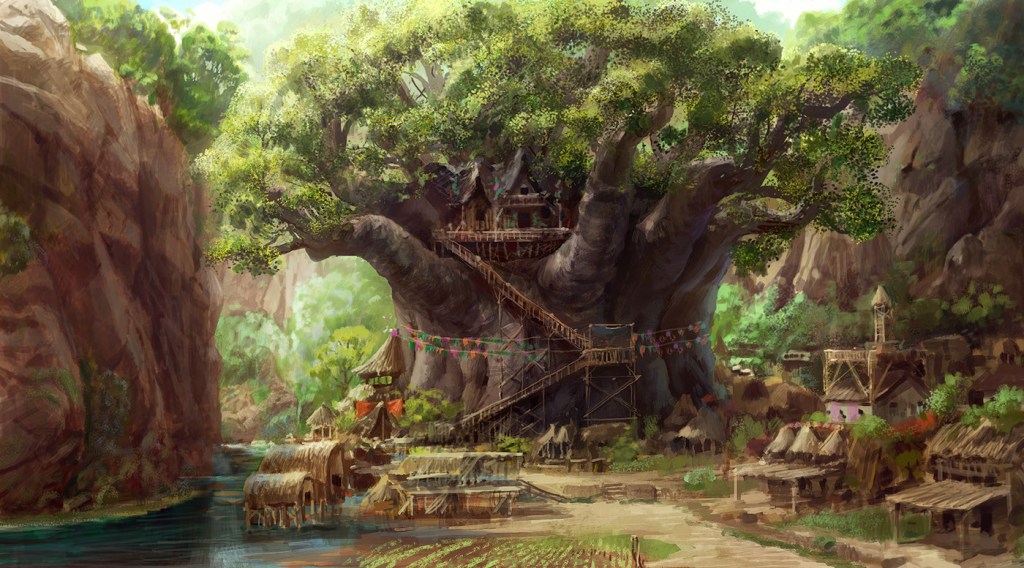
In response, I started to develop a genre I came to call “Brightpunk”. It draws on a range of current styles, solarpunk, cottagecore, hopepunk, noblebright, cozy games, Ghibli films, and others to build a style of TTRPG that keeps its intensity, but offers an aspirational, joyful vision of the world. At its heart, brightpunk is a style of game that’s cozy but proactive. It centers on adventurers creating a world they want, not destroying one they don’t. That’s not to say it lacks conflict, but the conflict isn’t generally the objective, and violence is often going to be a last resort rather than a primary tool.
I’m going to present here a kind of “Brightpunk Manifesto”, including some basic ethos of the genre, main tracks that adventures will take, and some thoughts on specifically adapting D&D 5e to fit the style.
A starting point to understand the aesthetics of brightpunk is to consider the 5 Cs: Culture, Community, Creation, Conservation, and Commonplace.
Culture: Brightpunk games should celebrate diversity among players, characters, and setting inspirations. In particular, there’s a push to imagine characters, both PCs and NPCs, complexly, highlighting where they came from, who they are now, and where they want to go, and how all of that shapes their culture and identity in a nuanced way. Lean into detailed backgrounds and use them as a hook for adventures. Remember also that many “monsters” can have culture; try to imagine them complexly, too.
Community: As an extension of culture, the social component of brightpunk games should be prevalent. Make the NPCs and settlements around the PCs more than a home base or collection of resources. Bring in quests to support and protect the community or even make building up a community a major plot point. Emphasize connections to the people and the place, and give social interactions and adventures a prominent role in games.
Creation: Playing toward positive objectives is a key element of a brightpunk game. Characters and NPCs should want to do, or create something and include that as part of their identity. It’s not just that they want to stop the antagonists’ plans or defend what is there, but they want to make or do something new. This might be on a large scale, building a homeland for their people as a campaign arc, or on a small scale, crafting items or running a business as a personal reason for adventuring. The idea of making something should be central to character motivations.
Conservation: Attached to the concept of creating, there is the goal of preserving, defending, and restoring what is there. This might be ecological, preserving the environment and protecting a species or an area of wilderness. It might also be cultural, supporting groups in danger or restoring elements of cultural heritage. Often this is what will drive conflict in a brightpunk game. There will be a threat to a community, to nature, or to something that is dear or significant to the party, that they need to protect in order to live the lives they want.
Commonplace: It is no bad thing to celebrate a simple life. Brightpunk doesn’t need to focus on globe-spanning quests, and when it does, the focus is on keeping the PC’s home safe, or getting back there after the adventure ends. The goals of a character in a brightpunk game will usually be deeply grounded and personal, focused on homes, families, and communities, rather than matters of global or cosmic importance. They may take on greater significance in a game, but the focus should be close to home.
Alongside the 5 Cs you can think of brightpunk adventures and quests as falling into the category of either bright or punk:
Bright adventures are hopeful and creative, things like finding a relic that’s important to your community, helping people develop a village, locating a McGuffin such as the cure to a disease or other solution to a problem.
Punk adventures are more focused on defending and resisting, things like developing a group to resist a tyrant, recovering stolen objects, or organizing underground/DIY communities.
A brightpunk campaign should ideally mix these elements. The bright adventures let the PCs explore and accomplish their goals. The punk adventures provide the conflict that moves a story along and increases the stakes of an adventure.
With all of that outlined, within a D&D 5e game, let’s explore the mechanics to support a brightpunk genre:
Gritty Realism: Ironically, slow healing, aggressive use of exhaustion, and other “gritty realism” rules can support brightpunk as much as they support grimdark, if not more. These rules slow down a game by forcing the party to take a week of long rest. They push parties to build a home, a place they can take those extended long rests. They also raise the stakes of combat, pushing players to look at violence as a last resort option.
Downtime: Connected with the slow healing rules, expanding the use of downtime lets players explore their lives outside of adventures. Slow healing contributes here, since the party needs to do something in that time during rests. Parties should have time and tools to work on their goals, interact with their communities, and live normal lives. Expanded downtime, as in Xanathar’s, is a great tool to do that.
“Correct” Social Checks: Social checks are one of the most misapplied rules in 5e. Per the rules, NPCs are either Friendly, Neutral, or Hostile, and social checks can be used to change those attitudes or look for support. By staying close to the book in social situations, you put the social pillar of play closer to the combat pillar in terms of mechanical importance. Also, I’d advocate for the methods suggested by Taking20, making social checks parallel to combat, with a check first, then a narrative, instead of the reverse like most groups play. This puts the emphasis on the character’s, not the player’s, skill and charisma. You could even incorporate the relationship rules from the Strixhaven setting for more mechanical support here.
Crafting and Tools: Just as social checks can put the social pillar on par with combat, more extensive crafting and tool mechanics can support the exploration or skill pillar of play. Creating is a major element of the brightpunk ethos, by backing that up with mechanical heft puts it at the center of the game. Using things like the expanded tool rules from Xanathar’s or third party content on ingredients and materials can help make that happen.
Less Lethal Combat: In the process of downplaying violence, death should have weight in a brightpunk game. Even killing an “evil” character or creature isn’t to be taken lightly. In that context, encouraging the use of things like trips, disarms, intimidation, and other nonlethal combat tactics, especially coupled with morale checks, can let PCs fight without seeking to kill enemies.
Home Bases: Communities matter in a brightpunk game and the PC’s homes should be significant. Again, adding mechanical weight makes that matter more, so the adoption of rules like the bastion system, Strongholds and Followers and similar content can support the party in building up their homes in ways that are specific and mechanically supported.
I hope you take a look at this genre of game. It’s an opportunity to take a breath, walk away from dark themes, explore a more hopeful world, and see PCs accomplish something that brings them joy. All too often, our real world feels dark and heavy, there’s no reason our fantasy worlds should, too.
About the Author
Joseph Gaylord has been playing TTRPGs and TCGs for 25 years, with almost 50 titles to his name on DMsGuild as an author, coauthor or contributor. He is on most social media as LabLazarus.
 RPG Counterpoint
Leave a comment