By: Jared Biti
In this article, I intend to address long-distance travel and how you can run it in your game. Both the travel itself and what mechanics can apply and what your player characters(PCs) can do during the time the travel takes. I will focus primarily on D&D 5e 2014 mechanics as that is what I am most familiar and practiced with but I will also sprinkle in mechanics from other systems and how they can show other sides to long-distance travel and its uses.
Long-distance travel can come up in the following ways. First, you need the PC group to travel from city A to city B. They happen to be about a week apart or at a steady pace in D&D about 168 miles – referencing the standard of 3 miles per hour and 8 hours of travel over 7 days. So if they are walking, they will be spending their time literally traveling and then setting up camp, looking for supplies, etc. You can use random encounter tables to spice up the time and fill it with activity. If you do not want to do that for whatever reason, then I suggest the simple “time skip” to where they arrive at their destination with an uneventful journey.
If they are traveling in a vehicle, which can include horse and cart, ship or airship, they have the opportunity to do other things. Depending on the situation onboard the vehicle, they can craft, practice, and skill or otherwise engage in productive skill use. This can be abbreviated to a simple set of roles or fully roleplayed out depending on the party and their preferences.
Examples of the things that can be done while on a cart would be fletching or leather crafting. On board a ship or airship, they can do those and other more involved crafts such as wood carving or glassblowing that require a workshop, assuming the vehicle possesses the space and equipment.
Traveller, a space sci-fi TTRPG, uses skill improvement to take up the time “in jump” between locations, which is a standard week. Around this one-week travel time, their whole skill “training” system is run where you can spend your week honing a skill. After so many training weeks, the PC can make a roll to see if they learned anything from the training and therefore improved the skill in which they have been training. Traveller also tracks consumables for these long travel times such as life support and food supply. The food and maintenance supply accounting, in particular, gives the chance to create side plots for the party, should they find themselves short on these supplies on a deep, multi-jump quest.
What I, myself, have done is use it as an opportunity to world-build by having the party run into various creatures and environments that help them engage with the world through which they are traveling. In the process, I try to give them time to interact with the world, not just pass through it. If this drags on, as I have had happen, you can insert an expeditor feature. I introduced a small experimental airship that was looking for crew. The party joined it with the exchange that the airship traveled in the direction they needed to go, thus shortening their in-game travel time.
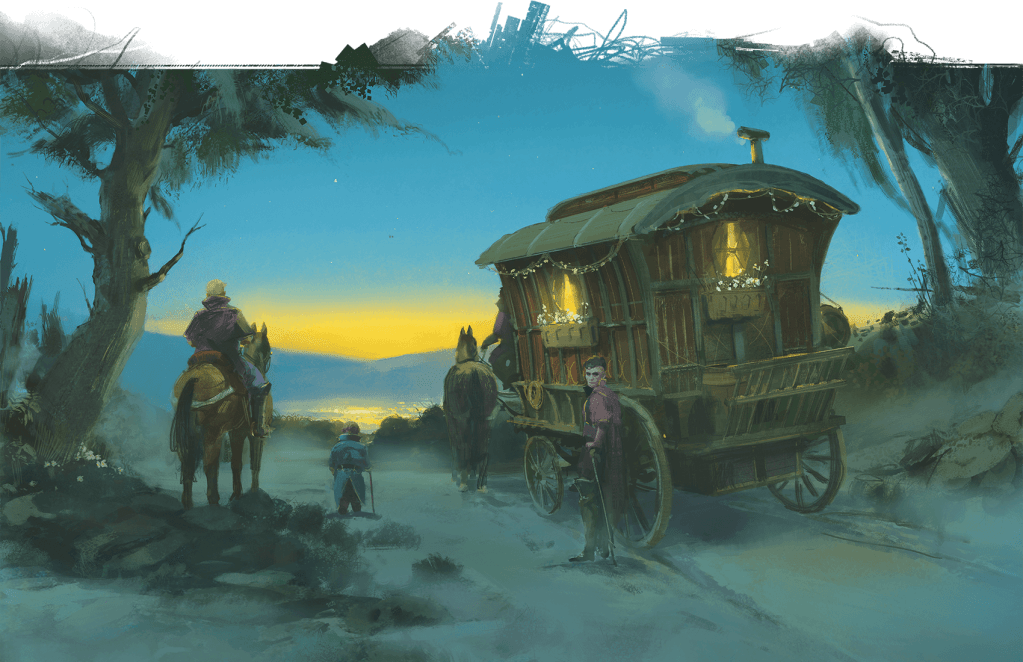
Many other systems touch on the need to use various skills to stay on course while traveling. This provides a believable plot hook for some of the encounters that can happen on the road, should the party be lost or have to take a detour. Provision foraging and finding a safe place to make camp also provide short-term motivations to play out the travel time in vivid details that draw your players into this otherwise “filler” time period.
You can also make the whole game about the journey. Think of the Lord of the Rings or other similar long-term adventure arcs where the whole purpose of the campaign adventure is to travel from one location to another.
I am planning to write such an adventure at some point to publish. The focus of this adventure will be to follow in the “Footsteps of Heroes”. The party will start with a small good deed in a town, then venture forth to follow the story of the adventurers that are the stuff of legend in their area. This journey will take them to various locales where the previous heroes went. With all this travel, each location is meant to be unique, with its own set of problems to solve, people to meet, and creatures to defeat. Thus, the location is not the focus of the plot; rather, the journey itself is the plot.
This also functions well as a world-building device to give you an excuse to flesh out areas between your areas of importance. This also allows you to offer little side quests from these small locales for the heroes to complete along the way.
The key is to find a way to strike a balance of knowing when to just hit the fast-forward button and skip to the destination and when to take your time and fill in all the little gaps that make up a long journey. Both base methods work, but overuse without proper engagement from the players can cheapen the experience. On the one hand, they do not become invested in the “small things” if you are always having them “fast traveling” to the next big city. And if you slog through every day on the well-maintained king’s road trying to get the party to interact with every boulder and tree along the way, they will become bored with either nothing to truly do or the chaos of random, inconsistent, unrelated random encounters just to keep them busy.
Balance, like many things in TTRPGs, is paramount, in my opinion, to keeping your players happy and engaged. Thank you for reading, and I hope this helps you or your DM/GM the next time an instance of long-distance travel occurs at your gaming table.
Game on!
About the Author
Jared “Martel” B has been GMing and playing in several TTRPG’s since late 2013. Enjoys the challenge of bringing his players worlds and stories straight from his mind in the moment that it happens. He is one of the Founders of RPGCounterpoint, happy husband to an active historian wife, and father to two puppers and new baby!
 RPG Counterpoint
Leave a comment