
By: Joe Gaylord (Lazarus Game Lab)
Random tables are one of those elements that a lot of current TTRPG designs have started to shy away from. The more narrative driven “collaborative storytelling” community see them as taking attention from the plot and wasting time at the table. The more character driven “Nordic Larp” community would rather see them replaced with elements that connect to character backstories. Many tables and whole systems have come to prefer “yes, and” style improv play over more traditional dice-focused attitudes.
And yet, I (roll for expletive) love them! I can’t get enough of random tables. I use them to determine travel encounters, the inn where the party stays, the starting attitude of NPCs, local rumors and side quests, and any number of other things. I’d use them to determine what’s for dinner if my wife would tolerate such nonsense in the house.
My favorite kind of table, though, is one that doesn’t ask me to roll just one die. Instead, my favorite tables are resolved by taking a whole set of dice and throwing them at once. They’re called blunderbuss tables, and they’re among the best random generators you’ll have the chance to work with.
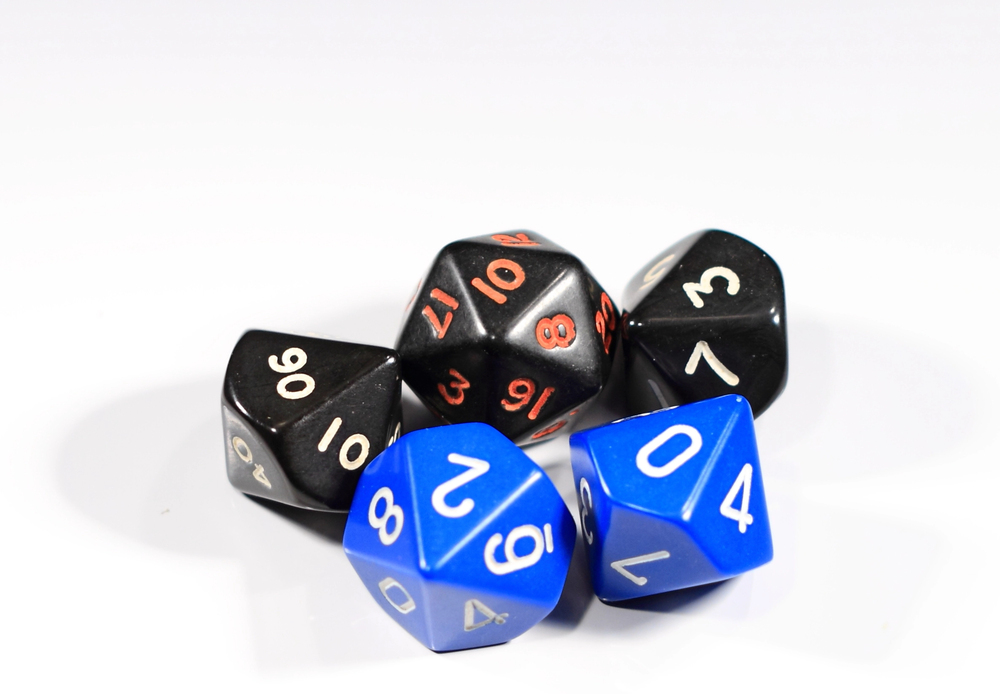
The primary role of a blunderbuss table is to randomize something complex or multifaceted. For example, you need a settlement, with a name, general economy, government, primary alignment, and dominant species, plus one or two features or sidequests. Instead of rolling for each feature individually, you roll a full set of dice all at once, assigning one element to the d4, one to the d6, and so on. Many dice sets come with 2 d10s and some with multiple d6s which can either be separate rolls or added together into 4d6, 2d10, or d% rolls, depending on your needs.
The biggest advantage of this kind of table, to me, is that it’s just fun. How often do you get to roll a complete set of dice in one go? We already have all of our beloved mathrocks out anyway, so why not just let them fly? It feels good and worries the players a little. On a more pragmatic level, this lets you get all your essentials together in one big roll, instead of consulting a series of tables. This is especially useful if you want to adjust an outcome or build connections between elements since you have all the rolls in front of you at once and can cross reference as needed.
Blunderbuss tables also add value to the level of randomness you can get from the table since you’re randomizing all the pieces individually. In our example of the settlement, a normal d% table with all the details together would have 500-100 pre-generated towns. This is good, but with use, it could start to feel both inflexible and repetitive. By randomizing each element, you get nearly 8.5 million variations, while only needing to generate 70 specific results.
You can also expand on this by clever table design. Wise use of multiple dice lets you control probabilities effectively. In our settlement example, this might look like having a 2d6 for primary species, with humans as 7 and something exotic like aasimar as 2 or 12. You can take this further by crosslinking your features in order to add texture and logical throughlines, either explicitly or implicitly. In our settlement this could look like a d4 for economic status, which is added to our d12 for major industry, ensuring that you are less likely to get an impoverished community with an economy based on magic item sales, or a wealthy one based on mud farming. Similarly, you could create a d% table for quests and rumors, where the d10 generates the town’s primary alignment so that the alignments fit with the other features. Extending this idea out, you can even have the position the dice land in matter, especially for something like a settlement, giving you not only a randomly generated town but the start of a map for it as well.
All of that said, these aren’t a perfect tool for everyone or for all situations. Creating a blunderbuss table, especially one that takes advantage of all the tool’s potential, takes a lot of time and creativity. They can also take some time to interpret, since you need to look up all the dice and sometimes crosscheck between the outcomes. Beyond that, as I mentioned before, randomness isn’t always welcome, sometimes players and GMs will want to create something through improv, or something that speaks to the core storyline or player backgrounds. Dice usually won’t work in those circumstances, except maybe as inspiration.
This means there’s a sweet spot for blunderbuss tables. You need something you want to randomize which will come up often enough to be worth the time investment, but not so often that you’ll bog the game down reading the table, say more than once or twice per session. Some of my ideal uses for blunderbuss tables are:
– Hexcrawls, where you need to populate hexes quickly.
– Survival games, where things like weather and the presence of animals will come up more or less daily.
– Settlements, where you need a town during travel.
– Small dungeons and side quests, where you need a variety of logical features on the fly.
– Shop inventories, especially for larger shops or market towns with an array of products.
– Solo or DMless play, where you want to randomize a whole story.
I hope that you’ll keep this idea in mind since it represents one of my favorite tools at the RPG table. It’s something that can be adapted to a wide range of situations and is a great excuse to roll an unsettling number of dice at once.
– Settlement table:
Roll d4, 2d6, d8, d00, d%, d12, d20
Total population: Take the total of all the dice and multiply by 10 for a village or hamlet, 100 for a town, or 1000 for a city.
D4 Economic Level
- Poor
- Working Class
- Middle or Upper Middle Class
- Wealthy
2D6 Dominant Species
- Aasimar, Genasi or Tieflings
- Orcs
- Gnomes
- Elves
- Halflings
- Humans
- Multiple main species, roll again twice
- Dwarves
- Goblinoids
- Goliaths
- Yuan-ti
D8 Government
- Pure democracy
- Elected oligarchy
- Feudal or monarchy
- Led by guild or business leaders
- Led by elders or cultural leaders
- Magocracy or Theocracy
- Military control
- Control by a secret cabal, reroll for the outward leadership
D10 Unusual Resident or Store
- A well-known retired adventurer or hero
- The last surviving follower of an almost forgotten deity
- One or more powerful interplanar visitors
- A dispossessed noble with a claim to the throne, true or false
- A notable scholar conducting research in the region
- A major caravanserai that regularly draws exotic merchants
- The primary source or manufacturer of a specific material or item
- A famous spa or place of healing
- An important temple or pilgrimage site, current or former
- A portal or passage to another plane
D00 Alignment
- Lawful Good
- Neutral Good
- Chaotic Good
- Lawful Neutral
- True Neutral (actively protecting balance)
- True Neutral (ambivalent or apathetic)
- Chaotic Neutral
- Lawful Evil
- Neutral Evil
- Chaotic Evil
D% Rumors and Side Quests
1-3. The child of the local leader has been kidnapped
4-6. The ruins on the hill contain a reliquary of an important deity
7-9. A local paladin has started to waylay people on the road
10-12. A mysterious disease is plaguing the community
13-15. Nothing has been heard from a smaller nearby settlement for weeks
16-18. A celestial has been seen in the local wilderness, asking cryptic questions
19. A family or community has been cursed by a coven of hags
20-22. An important cultural or religious object was stolen from the community
23-25. An evil army has set up a fort threatening the settlement
26-28. A gang in the wilderness is taking captives for ransom or slavery
29. There is a plot to overthrow the local government, led by a deposed noble in the forest
30-32. A rare tome was stolen from a local scholar or library and needs to be recovered
33-35. An abandoned castle can be claimed by anyone willing to keep it clear of monsters
36-38. A sphinx is blockading the road into town
39. The king or other major leader is going to hold a festival nearby this week
40-42. Two noble families have a feud that needs to be settled
43-45. A monster is corrupting a section of the nearby forest
46-48. A red and silver dragon are starting a war in the region
49. The town will host peace negotiations between two kingdoms
50-52. A crafters guild is in need of rare materials to complete a masterwork
53-55. A lost mine has been uncovered in the nearby hills
56-58. Giant animals are attacking people in the area
59. Regional factions of good and evil or law and chaos are quickly approaching a war
60-62. A natural disaster overtakes the settlement or another town in the area
63-65. A village or inn nearby is actually a mimic colony
66-68. The settlement’s larger neighbor is sending troops to tax them unfairly
69. A killer is stalking the local red-light district
70-72. A local noble is beholden to a thieves’ guild
73-75. A blackguard has established a corrupted fortress
76-78. A devil appears at the crossroads and will grant wishes for your soul
79. The local sovereign has died and a power struggle is inevitable
80-82. A local mage will pay well for unicorn horns and similar vile ingredients
83-85. A thieves’ guild has something the party wants
86-88. A necromancer is building up an army of the undead
89. An ancient artifact of evil is rumored to be in the possession of a villager
90-92. A leader in town wants a rival assassinated
93-95. The watch has found the lair of a deranged killer
96-98. Giants are on the march in the local countryside
99. A cult has opened a portal to the abyss in the town
100. There is a prophecy of a deity’s avatar being born in the vicinity
D12 Main Industry
(Add the 1d4 result)
- Little or no work to be found
- Tanning or tallow-making
- Herding
- Farming
- Mining or logging
- Market town or trade stop
- Black market or other crime
- Smithing, stonework, or carpentry
- Weaving or other manufacture
- Building vehicles
- Healing springs, medicine, or potions
- Pilgrimage site
- Local or regional government
- Education or research
- Magic items or services
D20 Town Name: Example
- (Color) Bridge: Redbridge
- (God of a shared alignment) Hill: Helm’s Hill
- (Geographic feature) Shire: Valeshire
- (Worker in local industry) Ville: Tannersville
- (Dominant species) Holm: Hobbitholm
- (Weapon) Gate: Spear Gate
- (Element or damage type) Burn: Waterburn
- (Animal) Kill: Deerkill
- Tree (Road feature): Treegate
- (Color) (Celestial feature): Rosestar
- (Color) Mount: Bluemount
- (God of a shared alignment) Church: Gond Church
- (Direction) (Geographic feature): Highvalley
- Mount (Tool for the local industry): Mount Pick
- (Dominant species) Feld: Dwarffeld
- (Weapon) Bridge: Axebridge
- (Element or damage type) Ton: Fireton
- (Color) (Animal): Green Trout
- Last (Road feature): Last Alley
- (Celestial feature) Lake: Moonlake
About the Author
Joseph Gaylord has been playing TTRPGs and TCGs for 25 years, with almost 50 titles to his name on DMsGuild as an author, co-author, or contributor. He is on most social media as LabLazarus.
 RPG Counterpoint
Leave a comment