By: Joe Gaylord (Lazarus Game Lab)
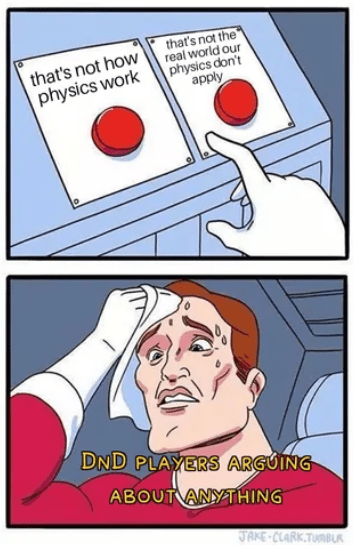
Many of the biggest debates that break out at TTRPG tables have to deal with science and “the real world,” whether because they deal with players who want their characters to knowledge from the real world, such as physics or chemistry, find corners of the rules that aren’t fully articulated, or because something is unrealistic enough that it becomes jarring for the GM or players.
“My player wants to turn a section of ice into a parabolic mirror and light an enemy fortress on fire.”
“I’m now a half-ton owlbear 30 feet in the air above my enemy, they must be flattened when I fall on them.”
“I’m 30 feet in the air, and that means that the distance isn’t 6 squares, it should be 30 times the square root of 2, which means I’m out of range.”
“If the explosion is strong enough to destroy a granite wall, wouldn’t it also burst their eardrums and deafen them?”
“To make that jump, you’d need a solid footing and the floor is sand, so you’ll be making the check at disadvantage.”
“Can I swim through the lava?” “No, you fall into the lava and die, no save.”
“So, I gather all 3,000 townsfolk and get them to stand in a line. I hand the last one a rock…” “FOR THE LAST TIME NO!!!”
Not only do these issues create a level of uncertainty in the game, but they can also cause problems with rules questions, represent difficult moments of metagaming, and create conflict between players and DMs. This happens in part because TTRPG systems are rules for games, not physics simulators. I like to start a game with a clear understanding of how we’re going to adjudicate these issues, based on the kind of physics models with which we assume we’re working. I talk about these as models, but they represent mindsets and philosophies related to how the table will adjudicate and think about the nature of the game. The models I like to use as baselines are: Strict Rules, Real Physics, Cartoon Physics, and Action Movie Physics.
A starting note: Yes, most TTRPGs include “impossible” elements, faster-than-light travel, superpowers, magic, supernatural monsters, and so on. They are part of the central conceit of the game and without them, the whole apparatus falls apart. You can’t play Vampire without vampires, Dungeons & Dragons without dragons, or Honey Heist without anthropomorphic bears. I assume that, whatever model a table uses, however realistic or however absurd, it will either handwave, account for, or incorporate those central conceits. There are examples of otherwise realistic settings that provide inspiration for accounting their central conceits, some that come to mind across different genres are A Song of Ice and Fire, The Strain, and The Expanse.
Strict Rules
This is often the simplest response. If it doesn’t say something in the rules, it doesn’t exist. Games are not physics simulators, they are games. You can’t create a magnet using Shocking Grasp, and when a vampire drinks blood it simply disappears. The advantage of this mindset is that it largely eliminates shenanigans. If it’s not in the game, it doesn’t exist. The problem is twofold. First, there are always going to be elements that the game doesn’t account for, and/or require obscure rules that force the game to stop while you look up something. Most games include a rule about DM fiat for these situations, but if we’re trying to hew as closely as possible to the rules, they will still present a level of challenge. Second, the rules can be clunky, and things stop being intuitive. You can’t get stabbed in the chest, take a nap, and feel fine. Diagonal distances shouldn’t be the same as those on a straight line. But that’s how the rules work, so that’s how it goes.
Real Physics
This is the opposite extreme from strict rules. Where that mindset says that when the rules and physics are in conflict, the rules win, real physics says that when there is a conflict, physics wins. The nice part about this is that it allows for a lot of creativity and feels “real” in satisfying ways. It can be fun for some players to understand how levers work in the real world and use that to solve an in-game puzzle or to have a character need to recover from injuries over a realistic timeframe. On the other hand, it can bog the game down significantly with debates over realism to play the game in this way. It can also either make character abilities feel over or underpowered when anyone can cast Fireball by using a torch and a bag of flour, or when heating metal magically can unlock a door.
Cartoon Physics
This model works well in less serious games. Physics bends to meet the requirements of the story when there are gaps in the rules or where the rules and science would come into conflict. You can think of it as moving toward things like Dragonball or even Roadrunner cartoons, or fictional worlds like Discworld or Hitchhikers Guide to the Galaxy. A player who wants to jump over a gap can use a dead snake as a whip and swing over. A powerful enough punch can cause an earthquake and a landslide. Three kobolds in a trenchcoat can pass as a human for a week or more. This is a fun and freewheeling style of play that rewards “yes, and” storytelling and creative solutions by both players and DMs. On the other hand, a style of play that lacks “normal” limits can feel unsatisfying and silly. There will be moments where a player’s gut instinct would be “That would never happen” or “That’s stupid,” and that feeling can take away from more impactful storytelling.
Action Movie Physics
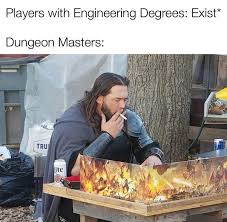
This is probably my preferred style and one that a lot of popular TTRPGs tacitly revert to. There is a notion that the game tries to account for real physics, but everything is more and bigger than in the real world. You adjudicate conflicts based on the rule of cool and making the characters seem as awesome as possible. Yes, an explosion that destroys a wall will also throw creatures across the room, but they won’t suffer severe internal injuries from the shockwave beyond standard hit-point loss. Not only can you cause a fire by cutting a gas main and sticking a magazine in a toaster, but you’ll blow up the whole building and look cool while you walk away. That critical hit will break an ankle and reduce your speed for a while, but you can be fine with a bandage and a short rest. This is fun because it highlights the heroic power fantasy a lot of people want from games. However, because it is playing toward being realistic while keeping big and conscious impossible moments, it can feel incongruous at times.
In the end, the biggest thing is that your table has fun. Whatever works for you works and your fun is never wrong. However, I think that there is a lot to be said for setting up one of these mindsets as a baseline during session zero discussions. Doing so avoids unfun arguments and moments of tension, and lets everyone focus on playing the game, without debating as much about “Would that really work”?
Joseph Gaylord has been playing TTRPGs and TCGs for 25 years, with almost 50 titles to his name on DMsGuild as an author, coauthor or contributor. He is on most social media as LabLazarus.
 RPG Counterpoint
Leave a comment