By: Christian /f. Kelley (aka FatherFletch)
The very real issue of disability, both permanent and temporary, is not often addressed in TTRPGs. If you would like to bring this topic to your table, first have an open and honest conversation with your fellow players. Respect and consent should always have a seat at the table.
When working with those differently abled, sometimes exploring familiar environments with an imposed handicap can let us experience their world. Navigating a grocery store with a blindfold and assistance, or having to move around the workplace in a wheelchair shows us how the world can be different and bigger than we first thought. Playing Warhammer 40k with a deaf player for the first time was personally eye-opening for this author.
Playing TTRPGs is an exercise in exploring a different lived reality. We play games to entertain and sometimes to escape the oft-harsh realities of life in this modern age. But what if we could find a way to both address physical disabilities AND have our game avatars engage alongside our able-bodied compatriots?
Enter the Exoskeleton
You are likely familiar with exoskeletons in their largest and most powerful incarnations, Mecha. Whether it is the Mobile Suits from Gundam (inspired by the powered armor from Heinlein’s Starship Troopers) or the towering Jaegers from Pacific Rim, their use in combat and dramatic settings is a part of contemporary fiction.
However, there are many other applications for this kind of machine. From medical prosthetics for therapy to reducing the ravages of manual labor, there is a place for exoskeletons in many TTRPG settings.
We encourage you to think about how this assistive technology might fit into your next game, add an element of the unusual to your setting, and if it could also allow a player to feel both recognized and able to fully engage in the fantastical setting in which you play.
Real/Contemporary

Since the 1890s, when Nicholas Yagn filed his patent (no. 440684A) for an Apparatus for Facilitating Walking, Running and Jumping, to today when multiple companies offer different exoskeletons for multiple uses, the desire to use mechanical assistance for common activities has been with us.
Generally, development, experimentation, and use have been in one of three categories:
- Medical Prosthetic and Therapeutic Use
- Mechanical Assistance for Labor
- Military Support for Infantry Endurance
As a medical device, the exoskeleton is used to help those with lower limb weakness or absence to walk. It is also used for upper limb physical therapy. These have progressed to a level of sophistication that exoskeleton legs are available as medical equipment for lease through some insurance programs.
In the workplace, upper limb exoskeletons are used in factories to relieve stress and injury on assembly lines and in tasks requiring repetitive overhead work. They are also being used in some warehouses to grant workers greater strength and endurance in repetitive lifting tasks. While the dream of mechanical assistance for fighting troops is not new, in this area, there are yet to be practical applications fielded. Limits of our present-day technology are what keep us from the power armor of Fallout.
Power
The first major limitation is power. Present batteries or generators are bulky, loud, expensive, of limited duration, or all the above. In any setting featuring exoskeletons, how they will be powered should be considered.
Will it be on the suit? Connected to a cable or feed hose? Require fuel and regular refills? Or will it take its energy from some unknown source?
Weight
While structural material science has advanced alongside power storage science, we still have material and weight limits on what an exoskeleton can do. If it is strong enough to act as a suit of armor, or powerful enough to lift tons of weight, it needs to be made of something equally strong. This comes at the expense of mass, and that greater mass takes more energy to move, even at a slow walk.
Currently fielded exoskeletons are made of material just strong enough to do the job. Advanced plastics, lightweight alloys, and the most efficient batteries available are in use today. Still not light in weight, they do what they need to without needless material.
Control
Early experiments used control systems wired to the exoskeleton. With the invention of the microchip and small lightweight computers these controls now are integral to the exoskeleton. Without the right hardware and software, an exoskeleton will be unable to offer the maximum advantage to its user.
Creation
An exoskeleton that could be ordered today costs thousands of US Dollars. While there are models available on Amazon, these are not the exoskeletons that fully replace working legs or arms. The lightweight, commercially available exoskeletons being advertised now are meant for otherwise healthy people to use as assistive technology and claim a battery life of up to 90 minutes. That a product like this is on the market points to future positive developments.
Models used in physical therapy, as full walking tools or for industrial applications, cost much more. This technology has even spawned a competitive race, now in its fourth year.
Building devices like this requires mature technologies across many fields and is representative of a well-developed technological society.
But what about different settings?
Science Fiction

The settings most often depicting exoskeletons are found in Science Fiction. Most often in the form of powered armor, but sometimes also as large construction robots that use a man/machine interface.
Almost every TTRPG rule set for Science Fiction has a version of powered armor first introduced by Robert Heinlein in 1959 in Starship Troopers. Given player focus on combat and wanting the best tools for their character, armor is usually at the head of the line.
For players and referees who want to explore the more peaceful implications of a Science Fiction exoskeleton can expand the options in play.
Since this setting often has “solved” the issues of power density and material strength, the exoskeletons are going to be lighter, more compact, and at the lower cost end, possibly concealable.
Have a low strength characteristic? Get an exoskeleton that offers a boost. If this isn’t detailed in the Gear section of your rulebook, it could be extrapolated.
- Find existing human-sized power armor, its mass, cost, and abilities.
- Find an unpowered suit of armor with similar capabilities, and subtract that mass and cost, and you will be close to the exoskeleton component.
- If the power armor has life support capabilities (like a space suit), be sure to subtract those equivalent masses and costs too.
- This will only produce an approximation, and you might want to keep some mass for the power system.
- In play, a low-powered exoskeleton might only bring a character’s physical attributes up to human norms, not make them a hulking brute.
For a referee, making exoskeletons commonplace in non-combat settings and scenes can help show this is a Science Fiction setting as much as space ships and laser guns.
For systems that use a Tech or Progress Level tree (Traveller, GURPS, Starfinder, etc.), a more advanced exoskeleton will enjoy the same benefits as their power armor kin.
Fantasy
Fantasy settings use magic as the tool most likely to augment characters’ abilities, or overcome disabilities. While it is a lovely thought to just wave a wand and eliminate a disability, maybe your setting is a bit less forgiving? Does your wizard have a low strength score? Maybe they have an exoskeleton to allow them to delve alongside the barbarian.
Possible variations of exoskeletons in a fantasy setting will still have the same considerations as in a contemporary or futuristic setting: material strength and mass, power sources, and control systems.
Here are a few variations:
Necromantically reanimated bones formed into a frame that lies along the limbs and torso of the character; powered by spirits bound to the exoskeleton. Is the controller a skull specifically enchanted to keep the parts moving together? Do they need replenishment or replacement? What dark magic might that be?
A sapling interlaced with vines brought to life with druidic magic that wraps around the character, needing only regular watering and plenty of sunlight. The controller could be a raccoon that lives in the “trunk” of the torso portion. Don’t stay too long in the dark dungeon or it might run down.
The gnomish tinkerer has constructed a whirring and clanking form of polished rare woods and gleaming metal, running on enchanted clockwork that is both power and controller. Be sure to wind it before the next job.
The cost and mass can be determined in a similar fashion to how it was done in the Science Fiction example. Find something equivalent like enchanted armor that boosts attributes like Strength and Dexterity, and deduct the price and mass of similar armor.
In many game systems, enchanting something incurs additional multiples of cost, and these need to be considered, but an exoskeleton that is primarily acting to bring a weaker or disabled character up to par with their adventuring peers shouldn’t be as expensive as something also acting as armor.
Steampunk/Dieselpunk
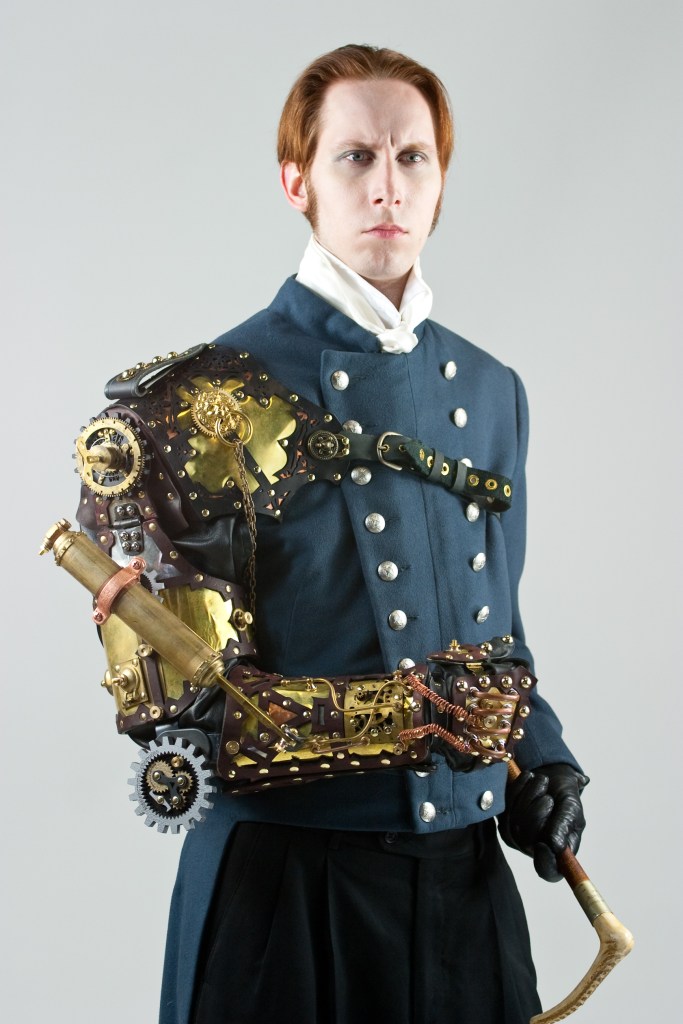
Steampunk or Dieselpunk fall more in the category of Fantasy. They often have tools and abilities that have the surface dressing of the early or middle industrial age, but with capabilities that are magical in nature.
Steampunk armor is certainly made with many gears, of brass, and puffs of smoke or steam from a compact boiler somewhere on the suit. A geared wheel like a player piano might be the “program” running this version. Perhaps a small coal bin lies on the hip to feed the boiler.
Dieselpunk will be made with steel, possibly aluminum, and have visible hydraulic lines in addition to gearing. An early vacuum tube computer is the controller, and its power source will be a chugging diesel or gasoline engine, and needs a reliable source of fuel.
As with all TTRPGs, the main goal is fun. Our hope is by adding non-combat exoskeletons to your game, you can add a bit of fun, a neat piece of background, and a way for players to think about the joy of being able to move freely and in the world without limitations.
Author Bio
Christian F. Kelley didn’t know how deep down the rabbit hole he would fall when his mom got him the hardback “The Traveller Book.” Ever since he’s been creating worlds for others to play in. Along the way he managed a major Tabletop Convention, had a family, and is now diving into putting his funny ideas online. You can find him online as Father Fletch. He acknowledges he lives on and thereby is a steward of the traditional homelands of the Puyallup Tribe.
 RPG Counterpoint
Leave a comment