By: Jared B.
I am starting off this year with the subject of non-combat encounters. Some call these social encounters or RP encounters. They could also be just challenges that are not played out in the traditional combat encounter structure. Either way, I will list and attempt to define several of these types of encounters and how I have used them in the games I have run. What I plan to cover here is as follows: Social Encounters, Environmental Encounters, Traps, and Puzzles.
Social Encounters. This is the traditional “talk to the NPC” type of encounter. Sometimes it is as simple as The Barkeep asks in his gravelly voice, “What’ll ya have?” But it can also be so much more than that. What I prefer to do, at least in preparation, is to give myself notes of what kind of character this NPC or a group of NPCs is. This is primarily to give yourself options of what the character might say or do when your players inevitably engage in some unexpected dialogue or actions in the presence of the NPC. We are going to use the above-mentioned Barkeep as our example. Let’s call him Rotus the Bull. A note layout I like to use is the following:
Name: Rotus the Bull
Race: Minotaur
Clothing: A yellowed shirt under a heavy, dark fabric apron that has many stains on it. (looking for about 1 sentence here)
Appearance: Tall male Minotaur with a farmer’s build of thick arms and shoulders, but with a soft midsection. (looking for about 1 sentence here)
Personality: He radiates that quiet power of someone who knows their place, and that place is wherever he is standing. His voice is low and gravelly but not harsh. Knows a lot about the farms and residents surrounding his tavern, the Thundering Twig. (looking for about 1 sentence here)
This kind of guide helps to introduce the character to the players, but also the personality bit allows you to, at a glance, have an idea what the NPC might know concerning questions the players may ask or how the NPC might respond to their dialogue and actions. I plan to cover more about making NPCs in a later series. For now, you can use the above info layout to note down your NPCs for these Social Encounters. How I use this type of Encounter is to communicate important information to the players. That could be environmental information, quest giving, lore of the area, or other NPCs they could talk to.
Next, we are looking at Environmental Encounters. These are things like bad weather or hazardous travel portions. While damage to the Player Characters (PCs) can happen in this type of encounter, there generally are no initiative or attack rolls made by the PCs. This type of encounter could evolve into a random combat encounter with animals and such, but we will not be focusing on that at this time. Again, with something like this, it is a good idea to give yourself a note of the generalities of what the PCs will be encountering so you can better judge how their potential solutions or reactions will interact with it. For this, I would use something like the following:

Area: The path north across the tundra, for 3 miles
Description: A blowing winter storm of snow and ice, heading crossways to the path of the PCs. (looking for about 1 sentence here)
Skill checks: Navigation rolls are at a disadvantage, and the occasional Strength save (DC 13) to keep from being knocked prone. Also, a Con Save (DC10) for every hour of travel against the cold or take 1D4 cold damage. No damage on a successful save.
Effect: While in the storm area, the PCs will have the blinded condition and will be fighting the wind and cold while travelling in this area. (This is a constant effect, typically not affected by the above saves.)
Again, this is so that you, as the GM, have a consistent idea of what the PCs are dealing with and that you can reference back to, as well as how their potential solutions will interact with this environment. Commonly, these kinds of Encounters are meant to stall the PCs’ forward motion by getting them lost in fog in the forest, or forcing them to hack their way through stiff undergrowth. It is meant as a world-building encounter to make the game world feel real, and where their PCs are travelling or currently existing is not convenient or enjoyable for their characters.
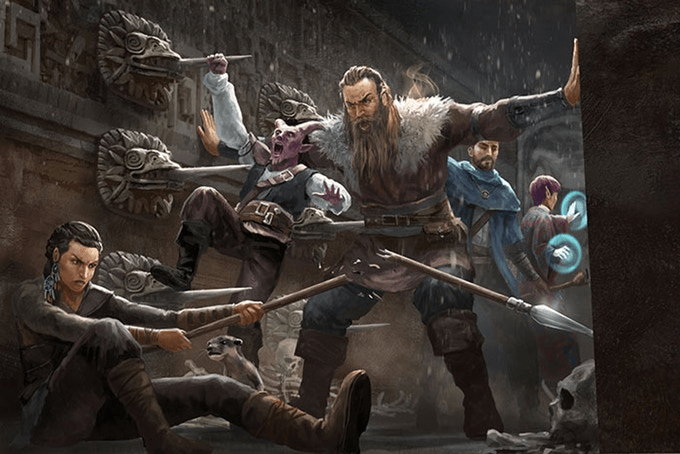
Now we are going to be looking at Traps. Much like the Environmental Encounters above, traps are intended to slow the PCs and give them an idea of the environment they are in. But rather than being a natural occurrence, traps are obviously created by another being. This typically is meant to tell the PCs that they will be meeting intentional and intelligent resistance to their movements and goals. So, much like a creature, traps need a stat block. For a simple one, see below.
Name: Pit Trap
Description: A 10-foot deep pit that is 5 feet in diameter at the top.
Type: Slow and rescue required.
Skill checks: Perception DC13 spots the trap. Dex Save vs. DC13 or fall into the pit. Climbing /Strength check DC13 to climb out.
Effect: On a fail, they fall into the pit and are trapped till they are saved or they climb out. (You can also add damage here if there are spikes.) 1D4 piercing.
For D&D 5e, at least, this also gives a way for you to use the CR system to assess how much XP to award your PCs once they have dealt with the trap. How I have used this type of encounter is that once the PCs entered a kobold domain, they started running into traps. This warned them of the upcoming hazards of the kobolds themselves. So they were alert and prepared when the kobolds engaged with them.
Finally, we are going to address Puzzles. Puzzles are somewhat unique because they typically engage the players more than their characters. But they can be useful in getting the players to engage with the lore of the world they are in. Similar to the other scenarios above, a basic stat block or information template is useful in keeping things straight.
Name: Guardians Platform
Description: A 5-foot diameter platform that has several concentric rings on its top surface with glyphs in different languages on each of the rings.
Skill checks: Perception DC14 to discover clue text on the side (The Guardian was placed here till the time of the flood returns), Insight DC14 to understand that each of the rings can be moved to align different letters.
Solution: Once the letters on the rings line up to spell out the word FLOOD, the platform opens, and a life-sized statue of the Guardian deity is raised up to be on the top of the platform.
I used the above puzzle to introduce that deity to a campaign and create a whole plot arc. But you can use it as a lock or a scypher. The primary goal is to get your players to be involved enough in the lore of the world that they recognise the clues from the world lore that would allow them to solve the riddle or spell out the answer on the combination lock.
I hope these have been helpful and help the GMs out there give more depth and flavour for your players in your non-combat encounters! Game on!
About the Author
Jared “Martel” B has been GMing and playing in several TTRPG’s since late 2013. Enjoys the challenge of bringing his players worlds and stories straight from his mind in the moment that it happens. He is one of the Founders of RPGCounterpoint, happy husband to an active historian wife, and father to two puppers and a toddler!
 RPG Counterpoint
Leave a comment