By: Joe Gaylord (LabLazarus)
In the first edition of Dungeons and Dragons, Gary Gygax stated that, “You cannot have a meaningful campaign if strict time records are not kept.” Thirty years of TTRPGs later, this quote has not fully held up. Many, likely most, games now are fairly loose about the passage of time, and few if any GMs are as methodical and obsessive as Gygax was about timescales (or most things for that matter).
However, even though the keeping of precise records has fallen out of favor, it’s worthwhile for modern GMs to consider time in the context of their game. Strict record keeping or no, a simple awareness of time’s passage can contextualize a lot of mechanical and narrative aspects of the game, and even provide inspiration for scenes and stories that rely on time.
Timescales
At the beginning of our conversation, let’s discuss how time moves in a TTRPG. Often, this is something a GM doesn’t have at the top of their mind in a game. I’d wager the average GM doesn’t know the date or time of day at any given moment in the game and isn’t considering how long actions or events take at the table, so it’s worth thinking about how different timescales influence the game.
Slow time
Usually, we slow time down in combat or while trying to do complex tasks that require rolls or checks. In D&D, for example, a round of combat is defined as six seconds, but often takes several minutes to play out. Similarly, the table may slow down if something needs to be looked up or adjudicated precisely, even if the event itself is very brief. In some cases, especially action scenes, we may even move into slow motion or even bullet time for dramatic effect.
When you slow down time, be careful to think about how long things really take. It’s easy to think that fighting a group of guards took half an hour, because that’s how long the scene took to play, but if time matters, like below, keep in mind that the fight was probably less than a minute. Likewise, a player may want to take their turn in combat to read a page of text, but if that round is 6 seconds, that’s not necessarily realistic.
Real time
Social interaction and some puzzles are usually the most common times TTRPGs use real-time, where the time in-game and at the table are the same. Conversations take the time they take, both at the table and in the game. For certain puzzles or other events, time is an important issue, and so playing in real time adds immersion and tension to the game. There are adventures and games, such as Strahd Must Die Tonight (https://www.dndbeyond.com/posts/359-strahd-must-die-tonight-how-to-play-ravenloft-in-a?srsltid=AfmBOorSoH7Rfzma2RcitlRwHqbRN9p07tiwLzZuY3iM7Q_X8s2IyWEH) or Paranoia, that rely heavily on time as a theme and source of tension that use real-time play consistently.
Fast time
Between downtime, travel, rest, and more, fast time is likely the most common way that TTRPGs are played. GMs regularly handwave away minutes, hours, weeks, months, or even years as part of a narrative. There’s no need to sit and play out every second of every event that happens; that much feels obvious.
However, as with slow time, it’s important to be aware of how much time passes when we speed things up. Everything moves at the same pace in the fourth dimension, so skipping ahead a month or two while players do research may mean that seasons change, children age, and enemies have time to enact their plans. That’s easy to forget when the research required only a few minutes and a die roll at the table.
Weird time
In fantasy games with magic and supernatural events and sci-fi games with advanced technology, time sometimes gets weird. Time travel and manipulation are potential elements. Time dilation due to high-speed space travel might also make things complicated as well.
In other cases, time can be weird for narrative reasons. You may want key events to happen in parallel or have the party arrive at a critical moment, and so adjust the time required for actions or travel to make it work. That way, the villain’s evil monologue about their foolproof escape is neatly interrupted by the other party members blowing up their spaceship in the next hangar over.
Time as a Game Piece
Beyond the simple passage of time, in some cases, time can actually present itself as a mechanical or narrative component of a TTRPG. Abilities can both influence and be influenced by the passage of time, above and beyond the simple notions of recharge time, casting time, or similar.
Time abilities
Time travel, faeries, specific magic, sphinxes, and more are common enough elements of TTRPGs. Creatures can be artificially aged, transported through time, time can be looped or rolled back, etc. Mechanically, these effects generally lead to rerolls or retries on failed actions or possibly bonuses based on having foreknowledge of events. They can also transform stories, think of Rip Van Winkle, who accepted a drink from mysterious figures in the forest and fell asleep for twenty years. This could be the basis for an adventure or the ability of a creature in a TTRPG.
Calendars and timed events
Beyond in-game mechanics or events, time within a setting can have a big impact on a game. The turning of seasons can make travel and wilderness survival easier or harder. Some items or creatures may be more or less common based on the time of year. Weekly markets make particular items available, but only if you are in town on the right day. Festivals and holidays can add to the flavor of a setting, or you might make astrology have a mechanical heft over the course of a year. On a grander scale, magic traditions may be tied to astronomical or geological events that take place over months, years, decades, or centuries.
Time Stories
Thinking more about time as part of the game also opens a wide range of story types for adventures and campaigns. All of these either require or strongly benefit from a mix of awareness of and mechanical or thematic support for time as a TTRPG element.
Ticking Clocks
Maybe the most obvious time story is a ticking clock. Some event will happen in a certain number of days, hours, or, for tables that enjoy anxiety, minutes. An asteroid impact is imminent, the kidnappers demand their ransom within a week, the players will die from a curse in a month, or any number of variations. In some cases, the counter might loop, with the event happening every time the timer reaches zero, like a city that floods at every high tide. Or, a character may have a disease that slowly weakens them before their time runs out. Tracking time is key here since every second is precious, and manipulating time, either through magic or delaying tactics, can become a critical feature of the game.
Generations
Another story type that benefits from a sense of time is one with a grand arc that spans generations. For example, a father defeats a dragon only to have it return and confront his daughter decades later. Immortal or near-immortal creatures fit neatly into stories that span mortal lifetimes, either as enemies that return time and again or as allies who remember the last time these events played out. These games can also use repeated events to explore themes of inheritance and legacy. A great game that uses this mode is “This is Not a Place of Honor” by Grant Howitt, the parallel stories of a doomed spacecraft crashing on an alien planet and the distant descendants of the survivors who have turned the ship, and the forgotten danger it contains, into mythology.
Time Travel
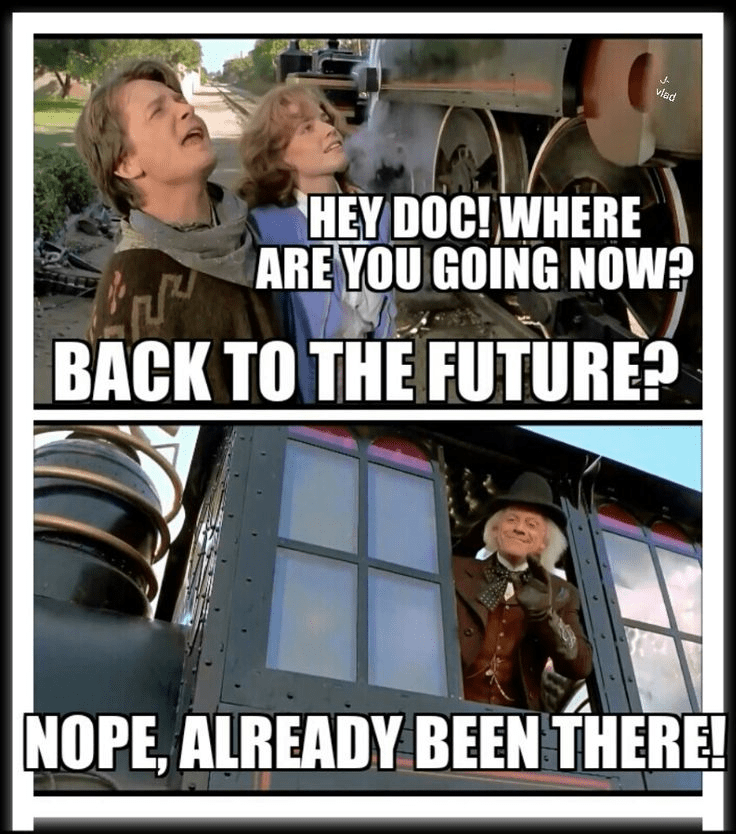
Another obvious time story involves time travel. Jumping forward or backward in time makes the passage of time extremely important. This can pair with the other stories here, either by having the character travel to meet past or future generations, or jump back to prevent an event before it happens. In some cases, this is a simple framing device, where the story of the game takes place after the characters have moved through time. In others, the players have means of time travel at their disposal as a tool in the events of the story.
Time Loops
Finally, time loop stories have a natural dependency on time. Reliving the same day, week, or hour over and over makes the timing and sequencing of events something that players can learn and take advantage of. How long the loop takes to repeat, what triggers the repetition, and when things restart from are things that the adventure will need to define and track, and which have a lot of mechanical weight. Especially if the loop takes a fixed period of time to repeat, the time required to complete actions becomes significant, since everything is happening within a repeated ticking clock.
Wrapping up or starting over
In the first edition of Dungeons and Dragons, Gary Gygax stated that, “You cannot have a meaningful campaign if strict time records are not kept.” 30 years of TTRPGs later, this quote has not fully held up. Many, likely most, games now are fairly loose about the passage of time, and few if any GMs are as methodical and obsessive as Gygax was about timescales (or most things for that matter)… Wait, did I say that already?
However, TTRPGs can get a big boost from thinking about the passage of time, time as a mechanical or thematic game element, and considering stories that rely heavily on time in order to work. You don’t need to keep “strict time records” but just giving time a little bit more time and attention is a great tool for levelling up a game.
 RPG Counterpoint
Leave a comment