By: Maryanne Cullinan
Remember the adage that when one player is attacked, we all roll initiative? One of the core features of most RPGs is that characters, and thus the people who play them, travel in parties. But there is a genre of games that you can play by yourself, solo journaling RPGs. One game that works very well is called Lighthouse at the End of the World.
A solo journaling RPG is, as you might expect, a one-player game where the player role-plays by writing the private account of a fictional character. Often this is set up as a diary or outgoing letters from the character to a recipient. There are many different genres of solo journaling RPGs, from cozy memoirs as a small-town witch-apothecary, to the history of a magical item that is passed from person to person, to exploring a giant, ever-changing continent-sized castle. There is a large variety of both genres and game elements in these games.
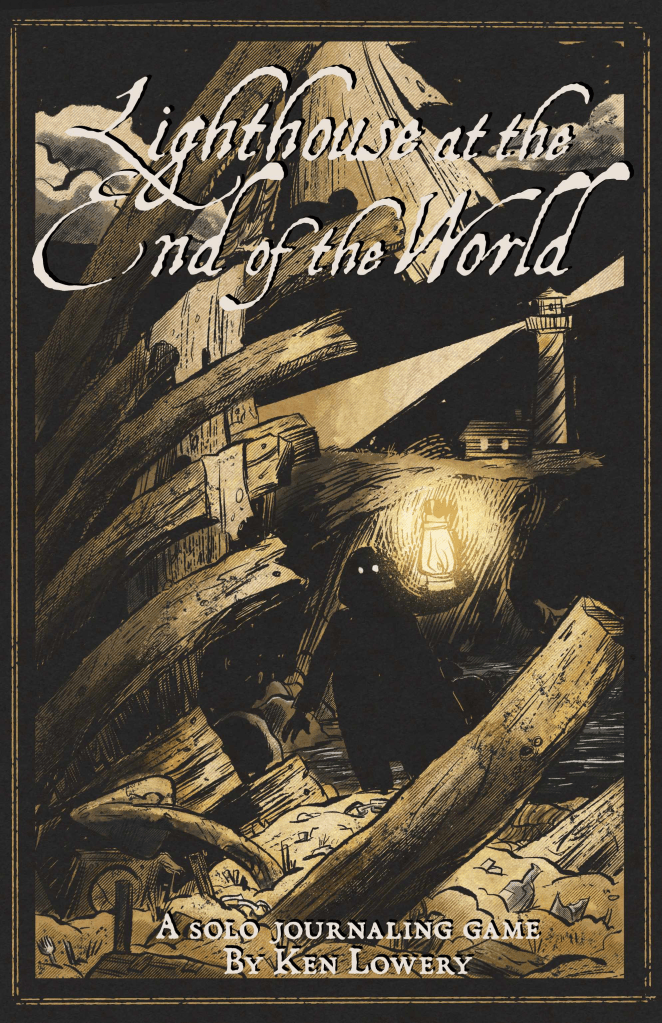
Lighthouse is a gothic horror game set in the Age of Sail, somewhere between mid 1700s to 1800s. The player role-plays as a nameless person with a mysterious past who has taken on employment as the lighthouse keeper on a far-flung island somewhere in the South Atlantic. The setting is based on a real island and a real lighthouse off the tip of South America, between South America and Antarctica. Before the Panama Canal was completed in 1914, commercial ships passed through these dangerous shipping lanes.
The titular lighthouse must be kept lit at all times, no matter what else is happening, the feelings of the lighthouse keeper, or what strange things happen on the very edge of perception. The lighthouse also contains the ghosts of ten people. Who exactly they are, how they got to the lighthouse, and how they can be put to rest is all part of the discovery of the game. The Lighthouse Keeper is in a race against time to keep their sanity, lay ghosts to rest, and above all else, keep the light on.
Solo RPG games have an increasing variety of mechanics that are different from what we expect in a more typical RPG. Lighthouse uses coins, a six-sided die, cards, and a Jenga tower. The primary mechanic is playing cards. Each card represents a short writing prompt – a question. Each round, the player rolls the die and then pulls that many cards to use as inspiration for the next entry. The coins represent the ghosts that still need to be laid to rest, and the Jenga tower represents the increasingly tenuous grip that the Keeper has on their own sanity. The game ends when four kings have been drawn, or the tower falls.
This game is based on a set of mechanics found in a space exploration game called Wretched. The Wretched and Alone mechanics have spawned many great games. When I spoke to Ken Lowry, author of Lighthouse, he told me that in all of the times he has played the game, he has never “won” it. This is, of course, not the point. The story of the Keeper’s descent into madness is the point. After all, the system is called Wretched and Alone!
This is part of why the game works so well. The vibe of the prompts is very gothic horror-inspired. The vocabulary, the pacing, and the content are old-fashioned, slightly unnerving, and allow for amazing creativity. It feels like living in a world where Edgar Alan Poe and H.P. Lovecraft might very well be on the next ship breaking on the rocks at your feet.
Many of the prompts focus on the day-to-day working of the lighthouse, or walking on the shoreline, finding flotsam and jetsam from previous wrecks. You may be combining prompts such as: “Quill and ink. Higher quality than anything you’ve had before. What makes you uncomfortable using them?”
“You catch a whiff of a scent that does not belong here: the perfume beloved of someone whose heart you broke. Do you respond with violence or melancholy?”
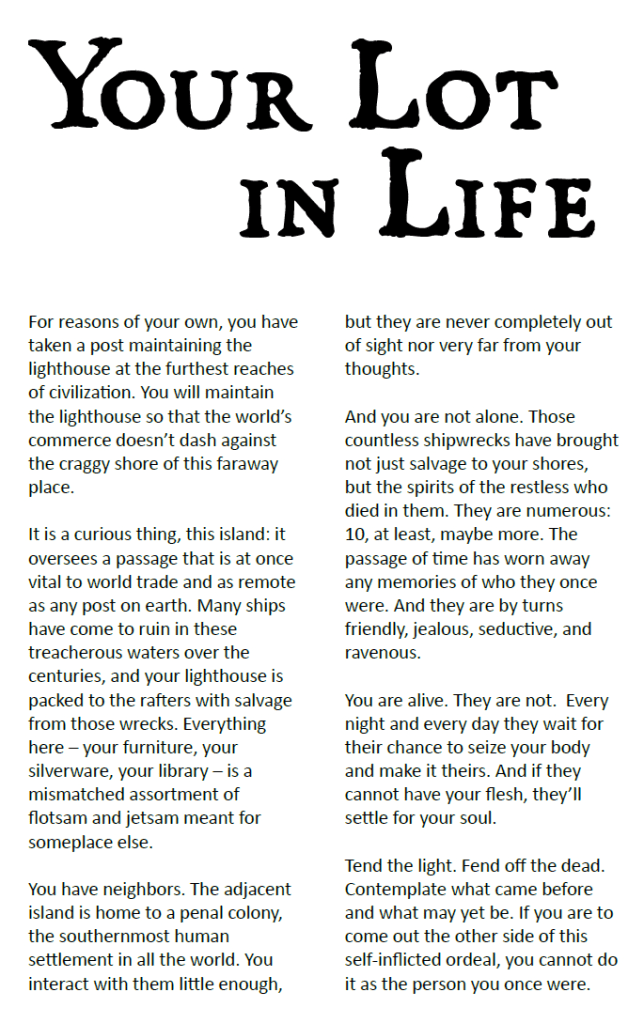
“The wick extinguishes, and it takes you all night to light it again. What miracle do you pull off at the last minute to stop a freighter running aground?”
There is a sense of loneliness, a thread of insanity, and the vague idea that the narrator you play may not be reliable, even to themselves. I have played a variation of this game with 8th graders for several years as part of our Gothic Horror unit. We have never actually laid all the ghosts to rest and escaped the island, but we have always had a lot of fun with our descent into madness.
If you enjoy writing, would like to learn how to write better, or just want to try on the role of someone else in a way that is very different from a traditional RPG, solo role-playing games are for you. If you want to have the experience of a slow descent into madness, over-the-top gothic horror, and high drama hidden in the storytelling of a narrator who may be hiding things even from themselves, then this game is for you. Just make sure that you keep the light on.
About the Author
Maryanne Cullinan is a middle school teacher, PhD in Education and Academic RPG Researcher. She multi classes as cleric/bard/cat herder. She is the co-founder of Tabletop.Edu and GamingThe System(s) Collective. You can check out some of her work on http://www.culliopescauldron.com/, at http://www.tabletopedu.org/ or say hello @culliope on Discord
 RPG Counterpoint
Leave a comment