Joe Gaylord, longtime contributor to the blog has some exciting news to share about his new publication, Tomes of Tarokka!
Jared: First off, tell us a little about yourself.
Joe: My name is Joe Gaylord, I am an American living in Northern Italy. I’ve lived in Europe for about 15 years at this point. I write and produce TTRPG content, mostly for D&D 5e. I usually write as Lazarus Game Lab, so you may see that instead of or along with my name on socials.
I describe LGL as TTRPG content by geeks for geeks. One of my favorite things about TTRPGs is that it lets me revel in being an intellectual magpie, and LGL’s material leans hard into that. I’ve studied and travelled widely, and I’m constantly learning about history, science, philosophy, and whatever my wife happens to be researching at the moment. I’m constantly curious and find myself going down rabbit holes and TTRPGs reward that.
An example is an AL Adventure I wrote, The Mournful Golem. A flesh golem named Theseus has been returning the body parts he is made of to their graves, leading to a string of apparent grave robberies. When the party tracks him down, Theseus explains that his maker is dead, and his mission is complete. Since his maker referred to his parts as “borrowed”, he sees it as his duty to return them. He asks the party to help finish dismantling him, aware that he will go berserk and fight back. This hopefully turns into a moral dilemma for the party, one player said “I came for a D&D session and an ethics class broke out” which already tickles that magpie instinct. But my favorite moment was when a player realized why I named the golem “Theseus”. That’s the moment I want for people running my content, I’m exactly that kind of nerd.
Jared: When and how did you get started in tabletop games?
Joe: I was 12 or 13. A friend of mine got an AD&D starter set right before 3e came out. Through high school and college I played a lot of 3e, World of Darkness, a couple other systems, including making my own. We spent years doing the full Stranger Things deal, a bunch of maladjusted nerdy teenagers sitting in a basement, rolling dice. We were only missing the psychic friend.
That’s where I got to explore part of that magpie-ism. I have a huge stack of old Dragon Magazines still in my mom’s house. Every issue explored a lot of topics and had something that I could deep dive into, from the sociology of hobgoblin cultures, to the history of Port Royal Jamaica, to the symbols of heraldry. That instinct never left my attitude toward the hobby.
Jared: What made you want to make content specifically for tabletop games?
Joe: I fell out of the hobby for a while after college. In 2017 I had immigration problems in Italy and I had to spend 6 months back home in the US waiting for my tourist visa to reset. While I was back home, I played a 5e one-shot and fell right back in. That turned into a campaign for my nieces and nephews and a couple high school friends.
When I was going back I had written a pile of notes that I had used maybe half of. I complained to my nephew that it was going to be wasted without a group to play with in Bologna. He told me I should publish it and explained about DMs Guild and how easy third party content was to make. DMs Guild was really hopping at that point, and the opening of the campaign became “Of Halflings and Hippos” my first published adventure.
There were some tables I played with in Italy, but writing adventures and supplements quickly became my main way to interact with the hobby.
Jared: Next tell us about the beginning of Tome(s) of Tarokka?
Joe: I love ephemera at the table, so I got the tarokka deck prop for Curse of Strahd the first time I saw it. It’s basically an in-world tarot deck for Ravenloft, it’s extremely gothic and atmospheric. I love it, but there isn’t much you can do with it as written. There are two tarokka readings in Curse of Strahd, one game to play with the cards, and some guidelines for how to do a reading, but that’s kind of it. It’s a surprisingly limited product for something I like a lot.
When Wizards announced the Book of Many Things, I asked one of the DMs Guild servers who was going to make a parallel supplement based on the tarokka deck. That’s a typical move with DMs Guild creators, riff on whatever official material is coming out to cash in on the hype. Nobody was doing it, so I said, “Well, I guess it’s on me!”
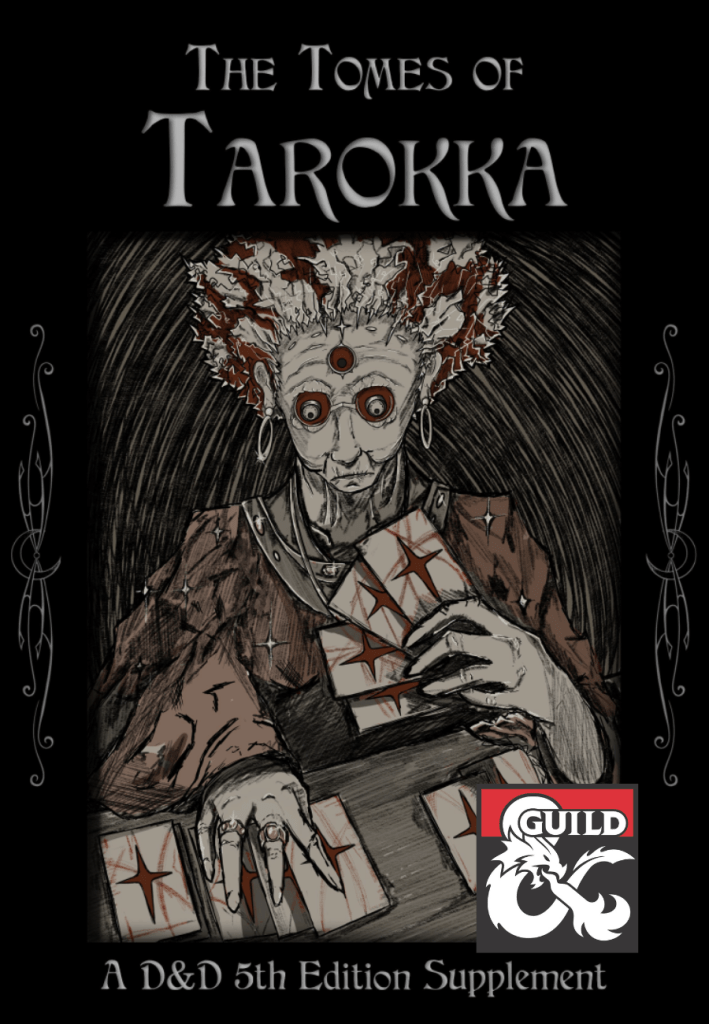
I was already noodling about a gambling based supplement, since I love mini games almost as much as ephemera. The two elements worked together well, became a theme for the project. I got together a great team of writers and designers, and we were off to the races. A late addition was some tools for solo play, since that was, and still is, really hitting with the community.
The book took a lot longer than I expected to come together. I honestly expected to throw some text together and just run with it, but people were really committed. It turned into a two year project that was way deeper than I expected.
Jared: Tell us what made this project important to you? Why did you feel the need to put it out there for others to use?
Joe: Like I said, I love ephemera and mini games. I got really into the image of running a game where fortune telling has both narrative and mechanical weight. It let me nerd out like I was talking about before on how casting bones or dream interpretation work in real world cultures, and from there how I could build those as in-game tools. Because fortune telling is so diverse and has such cultural resonance around the world, the world building and multiversal content became a rich space for exploration and inspiration.
I also gathered a fantastic team around me who all did great work that I fell in love with. I’m going to shout out a couple of favorites.
Devlin DM created card games with a really mind bending interdimensional card dealer, called the Smiling Croupier and whole system for tarokka based heroic inspiration mechanics.
Morgan Eilish did incredible lifting on the world building and random tables, including a cult based on trying to find the origin and history of the tarokka deck that can work as enemies or allies.
James Quigley made a killer set of tables, items, monsters, and quests including the Star Beast, a monster that hunts fortune tellers.
Colin Epstein brought in another organization and Silence of Stars, a tabaxi fortune teller NPC seeking his lost twin.
Blake Jones built some great subclasses, my favorite is the Way of the Augur Monk, which draws on wisdom from the tarokka in the same way some real world martial artists might use the I Ching.
Matthew Campbell worked on NPCs and subclasses, but my favorite part of his work was doing the math on how to simulate tarokka decks with dice. 54 is not a number that plays nicely with any standard TTRPG dice, but he made it work somehow.
Lauren Campbell was amazing for having edited what turned into a 124 page monster, and Erin Tierney provided this beautiful layout.
I have to specifically shout out our artist Hefestus Cave. We had an artists on the initial team who ghosted me, so he came into a project that was 90% done and 2 years behind schedule, and absolutely killed it.
Honestly, if it wasn’t for this group, I would have dropped the thing. At some point I was burned out with half the book to edit, and what kept me going more than anything else was not wanting to have wasted their time. I’m glad they kept me going. Tomes of Tarokka ended up being such a special, unique, product, the kind of thing that I wish I’d had before with some of the tables I’ve played with.
Jared: What can people expect if they purchase this gaming resource?
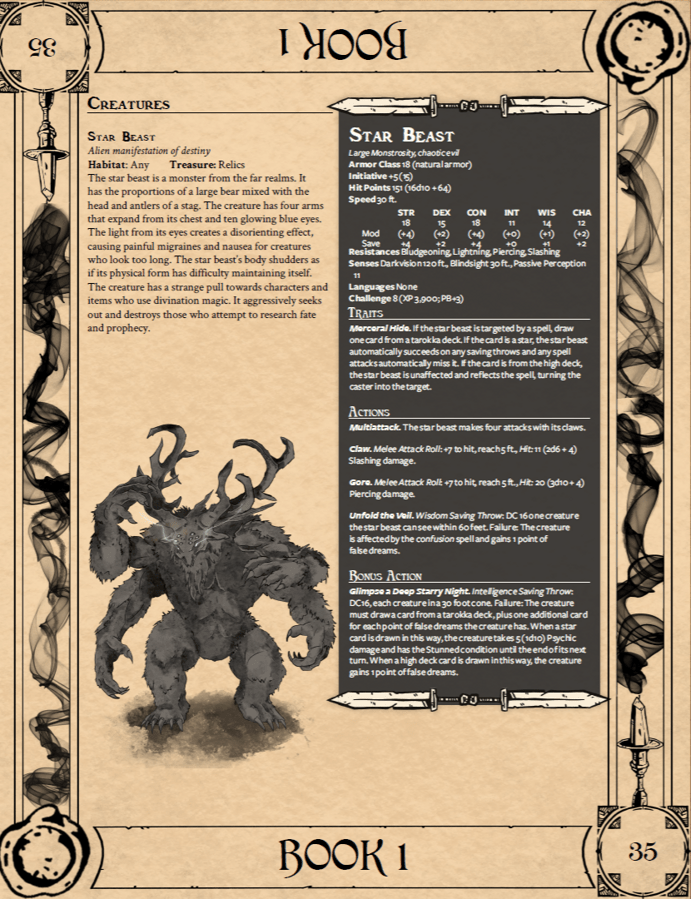
Joe: Beyond what I called out above, Tomes of Tarokka was built to give fortune telling and gambling a central place in a campaign or adventure. In particular, it makes all of that immersive in cool ways.
There are new spells, backgrounds, feats, and rules for oracular tools that let PCs be fortune tellers. Fortune telling is explored in the context of all the major settings with story hooks, NPCs and organizations for any setting.
As I said, a major goal was immersion. There are 4 subclasses, 10 items, 3 card games and 2 quests that directly use tarokka cards for their mechanics. There are also rules for simulating 7 fortune telling methods, along with notes on in game cultures that might use them.
The most immersive element, though, are the random tables. Just as the tarokka deck can drive part of the narrative for Curse of Strahd, you can perform tarokka readings or other fortune telling in place of random tables and even combine them into spreads that describe whole adventures. This provides a new structure for solo play, where the tarokka readings take the place of a GM to define the world.
Jared: What do you see as the future of this book? Goals?
Joe: Honestly, I want people to pick this up and use it. This is a side hustle for me, so one story from a fan who loved the book is worth a thousand sales to me. I’d take a thousand sales, too, though, don’t get me wrong. Medalling or best seller status would be fantastic. I plan to submit it for Ennie consideration, too. This book took a lot of work, and it deserves to thrive and exist in the world.
Jared: What other projects do you have coming up?
Joe: I have a couple long term projects in process. I plan an anthology of Bright Punk resource books, bastions, classes, items, NPCs, etc. I’m also working on a Ravenloft Spelljammer crossover that riffs on classic sci-fi horror tropes called Ravenion Nebula. If I have time in my release and work schedules, I’ll get back to me ABCs of D&D series, too. Those will come later this year.
Short term, I should have a fast project of D&D rules for Winter Olympic games launching together with the opening ceremony so your players can do ski jumping or curling along with the athletes.
I’m also gearing up for Zine Month and a 72 hour game jam in February, but the details for those will be emergent, that’s the point.
Jared: Anything else you would like to add?
Joe: Check out my articles here if you like the vibe of LGL’s work, they follow the same thinking as my other content of smart gaming, by nerds, for nerds.
 RPG Counterpoint
Leave a comment