Written by: Trip
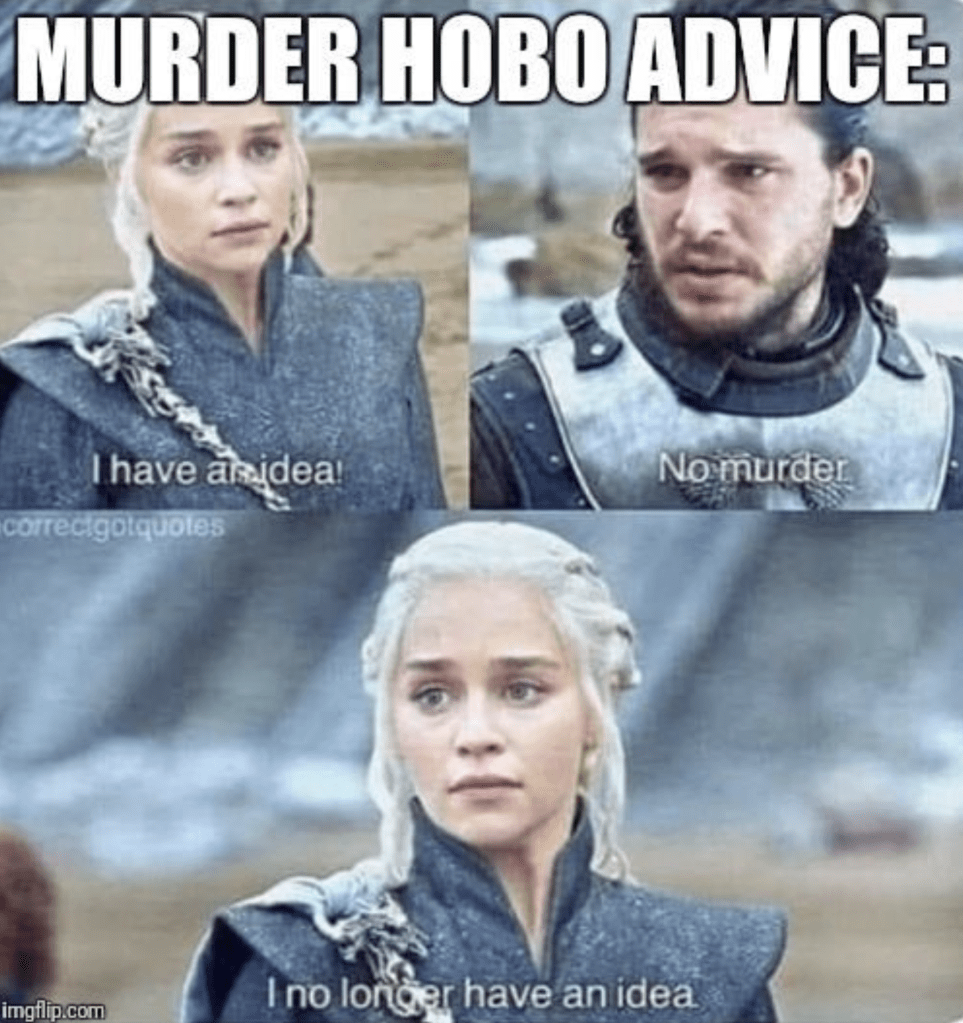
For as long as we’ve had TTRPGs; so too have we had players in those TTRPGs that disregarded the storyline in favor of burning down their 12th orphanage this week. Or the player who wants to threaten to kill every shopkeep, who refuses to give them magic items for free, and the player who gets frustrated whenever the party tries to solve a problem without violence and casts Fireball in the center of a crowded room during negotiations. We have all been there.
Why does this happen? More specifically, why does this happen so prevalently in D&D that nearly every table will have at least one Murder Hobo per campaign? Is it just because of our naturally violent tendencies as human beings, or is there something deeper going on under the surface?
Before we can answer any of these questions, first let us make sure we are all on the same page:

What is a Murder Hobo?
On its face this seems like a fairly easy question to answer, right? Unfortunately you cannot come to a straightforward answer by simply combining the definitions of Murder and Hobo. A player can be a Murder Hobo even if their character is no more bloodthirsty than another player’s character. Of course, having a roof over their head has no bearing on a character’s Murder Hobo status.
So what is a Murder Hobo then?
In my mind, and for the purposes of this article, a Murder Hobo would be defined as such:
Murder Hobo: “A player that is primarily interested in killing, looting, and otherwise causing destruction, while being disinterested in the role-playing and storytelling aspects of the game.”
So then, now that we have a definition, we can finally get down to the question:
Why do D&D players become Murder Hobos?
There are many reasons for basically every behavior players exhibit at any given table. If I were a Psychologist I could compose a list of personality factors that cause players to lean towards Murder-Hobory. But I’m not a Psychologist so I will spare you all the psychobabble.
I’m going to focus more on the factors that are specific to D&D. Firstly, because that’s more aligned with my area of expertise, and secondly because I’ve never heard of Murder Hobos plaguing a game of Thirsty Sword Lesbians. While my experience with systems outside of 5e may be limited, I’ve had enough experience to know that this is a problem that is most-prevalent in D&D and other similar systems.
So why does this occur? What is it about Dungeons & Dragons that seems to bring out the worst in people?
I could focus on the fact that 90% of the game’s mechanics revolve around dealing damage until one side of any given conflict is reduced to 0 HP, and that having more robust social and exploration-based mechanics would go a long way towards encouraging players away from violence as the solution to every problem.
I don’t think that’s it. Yes, it’s fun to throw a Fireball or swing a greataxe, but it’s also just as fun to roll a Performance check to dazzle a crowded tavern with your musical talents, or to make a Survival Check to navigate your party back to civilization after some bad directions got you lost in the woods. For every Spell in the game that deals damage, there are just as many non-violent utility spells that are designed to be used outside of combat.
So what’s the actual problem then?
It’s simple, really: Progression Incentive.
How do players progress and gain power in 5e? There are exactly three methods through which players progress:
- XP: Players gain levels and become more-powerful by gaining XP from defeating monsters.
- Gear: Weapons, armor, and other tools are the second means by which characters can become stronger. While basic gear can be purchased with Gold, magic items and more-powerful weapons are generally not found on store shelves. The most efficient way to obtain magical gear is by delving into dangerous dungeons and taking them from the dark denizens that live there.
- Gold: Gold is distinct from Gear, in that it can be used to empower your character indirectly. You can hire mercenaries, bribe guards, purchase a fortress, and so much more. Really the only problems that can’t be solved with Gold are the problems people throw Adventurers at. Though by far, the most efficient way to get gold is the same way you find better gear; by looting dungeons and monsters for all the valuables you can carry.
See the connection? All three methods of progression involve violently taking what you want from other living (or sometimes non-living) things. There is no XP bonus for role-playing well. You don’t get a free Holy Avenger by studying the lore of the world. Even a low-level Adventurer can make more Gold in a day by killing the Basilisk in the nearby cave than they could make in a year by doing literally anything else.
The way your game is designed will incentivize players towards certain actions. Humans like to watch numbers go up, and D&D 5e is designed to reward players by making numbers go up for killing everything that moves and looting all the bodies.
What’s the solution?
Now that we have a better understanding of the problem, how do we solve it? Well, the first question you should ask is whether or not the problem needs solving. I once heard D&D described as “A Tabletop Wargame, with light roleplay elements tacked on”, and I can’t say it’s an inaccurate assessment. Since we’ve already established that most of the rules in D&D are centered around combat, is it such a bad thing that the progression system rewards that?
As with nearly all things, it only becomes a problem in excess. A Barbarian player wanting to hit things with their greataxe isn’t exactly an unreasonable demand. It’s when that becomes the only thing they are interested in, that it becomes disruptive to the other players. So how do we solve this?
Obviously the simple answer is “Don’t play with a**holes.” but beyond that, WOTC has actually taken steps to help mitigate this problem with the implementation of Milestone Leveling.
For those uninitiated to the idea, Milestone Leveling removes XP altogether and instead allows the DM to decide when the party has earned the right to level up. Most official adventures published for 5e that I’ve seen actually recommend using Milestone Leveling for their campaigns, and include guidelines on where and when to level-up your party.
I’ve played in games with both XP and Milestone Leveling and I can firmly say I’m a fan of the latter. It just feels far-more impactful to me to have your character progression tied to the story progression. On top of that, it gives players and the DM one less thing to keep track of. I’d call that a win/win.
Now, while this does nothing to solve for the Gear and Gold incentives, those factors are decidedly secondary when compared to the XP incentive. As we already established, in a game where most of the rules and mechanics revolve around combat, tying at least a part of the progression system to combat just makes sense.
In conclusion, Murder Hobos can be a nuisance and can even bring a swift end to a campaign or even entire friendships if left unchecked, but they are not quite the Boogeyman that the horror stories would have you believe. Understanding the mechanical incentives that lead to these sorts of behaviors is the first step towards knowing how, and when, to correct it.
About the Author:
My name is Trip and game design is my passion. I started out with D&D about 10 years ago, but have played a few other systems like Fellowship and Monster of the Week. I’ve even tried my hand at designing my own TTRPG a few times (maybe one of these days I’ll actually finish one?) I love both playing and running games, but I also love the oft-overlooked joy of learning new game systems. It always sparks my imagination seeing a new take on mechanics and rules, and I’m always excited to test the boundaries of those rules to see if they work as-intended and whether they can be improved upon. Who knows? Maybe someday I’ll successfully create my own game and become a household name in the TTRPG sphere? A boy can dream. 😅

 RPG Counterpoint
Leave a reply to Happy 2nd year Anniversary to RPG Counterpoint! – RPGCounterPoint Cancel reply