
A controversial subject to some, and to others a moot point. Do you plan your campaign or game around a railroad or on a sandbox? Well, let us start by defining the two. Even with definitions, there are differences of opinion and connotations with each.
For this, I will be using my definitions of the words but also attempting to explore what others may define them as and other viewpoints on it.
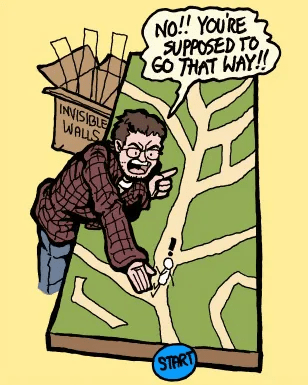
Railroad style: A straight path in the story from point A to point B, with little to no side quests or other possible routes for the players to take. Some call this Linear Game Progression.

Most published campaigns function this way, as it is very hard to have enough “branches” of side quests to make it more than a singular plot, without making the campaign book an encyclopedia on its own.
A common negative definition here is that the GM does not allow the players the ability to control their characters. It takes away the agency of choice. A good way I have heard this defined is: The GM can control what the player characters do, i.e. save the orphans, but not how they do it
Sandbox: A completely open environment where the players just do whatever they want with their characters and the world reacts to them. A lot of homebrew games at least start out this way. A lot of players think they want this as well. The flipside is this method puts a lot of weight on the players to “What would you like to do now” rather than the GM giving them a plot hook to follow. It also means the GM has to be either very familiar with his/her world or be very good at ad-libbing their way through whatever the players decide to do. This puts a lot of pressure on both the players and the GM. Some call this “Open World”. I would argue that Open World still has some Linear to it, leading to the next definition.
Railroad through the Desert: I define this as having a main storyline that the player characters probably should follow at some point, to actually finish the game, but also has multiple planned and unplanned side plots that help flesh out the world and tie in the characters themselves, their backstories, etc. Without this, it is a little dry. Unfortunately, it is very hard to achieve this without having pre-generated characters that are specific to that campaign.
Most players are also more familiar with the plot hook method and a level of linear campaign model as most published adventures, as said above, are this way and video games are very much this way. Even the “Open World” type of video games that are more popular now still have the main quest and a limited number of side quests that do not really contribute to the main quest line. Little achievements and such help to engage the players in exploring the open world, because face it, players don’t do anything unless they are getting character experience or loot of some sort out of exploring and interacting with things outside of the expected story arc.
Now, how do we apply this knowledge? Well, first I think this boils down to an honest discussion amongst the players and the GM of a given campaign. The group may want a strict, obvious plot so they can play their characters and just have fun. Others may want a sandbox approach even with the knowledge of the responsibility to decide what their characters do and how they are going to act. And lastly, the GM has to decide what he/she is comfortable doing. Some GMs, particularly new or inexperienced GMs, will find doing the published campaigns to be easier until they are able to craft their own stories and worlds. As such they need to work with their players and find a style of game that everyone is comfortable with.
If the group has decided to go pure sandbox, this is my advice for both the GM and the players. For the players, you need to clearly lay out the personality of your character. How they react to things, simple and straightforward motivations. What makes them tick and how are they likely to react to a given scenario? Hand a copy of your character’s history or personality summary to your GM so that they can keep that on file to help them craft the environment’s reaction to the character’s action and it will help the GM weave in things that make sense for the characters. Additionally, players, you need to have an idea in every scenario and setting the characters to find themselves in, what your character will do. Think about it like you would between actions in combat. You need to be actively thinking, “What is my character’s goal here, what are they going to want to find, do, create, destroy, seek out, etc?” That way when the GM asks “What do you want to do?” you have an answer. Use those things you gave to your GM about your character to help guide your planning like you would when you look at your character’s abilities and skills in combat. “What does my character do next? And then? And then?”
For the GM, ask for what I just told the players to give you. A brief but reasonably thorough background for their character, their character traits, and any NPC connections they want their character to have, within reason. You will have to filter some of this or encourage more info out of the players depending on their personality, but that boils down to good, clear communication. Keep all this information in an organized format that is easy for you to use and reference during sessions. Secondly, you should go ahead and design the starting “zone”. The area where the adventuring party starts. This can be a Tavern, an Inn, or an Adventurer’s Guild. Whatever makes sense. Do not worry too much about what story you plan on telling. With the sandbox method, the players make the story. Your job is to craft a world that reacts to them. So start small, the starting location, and then work your way out. District, County, Kingdom? And start filling in important NPCs just like you would for normal world-building.
For your NPCs make sure you have their personalities documented. Likes, dislikes, things that irritate them, things that will endear the player characters to them, etc. So when the player characters interact with them, you already know how the NPCs will respond. The best planning you can do is for scenarios, things that are going to happen whether the player characters are there or not, whether the player characters interact with the scenario or not. Again this goes with having personality traits planned for the NPCs. So if a highwayman holds up a merchant on the road leading into your little town that has the tavern or inn where your player characters are, they may happen to wander out of town at the same time and direction as the merchant. How will the highwayman respond? Will he hold up the whole group or will he wait for another target? What does his ideal target look like, etc.? And the biggest thing is to be ready to adapt. Armed with the player character’s backgrounds and personality traits, you should be able to anticipate most things, but there will always be things you did not count on. Be ready with those prepared “scenarios” to fill in for a random side step your players take with their characters.
Now, Railroad through the Desert. With this, the advice is much the same as it is for the sandbox, but it is easier in one way and harder in another. We are trying to get the best of both worlds. A little easier planning for the GM, and clearer direction for the player characters that the railroad provides, mixed with the flexibility and freedom of choice that the sandbox offers. For this, the players need to engage with the main plot like they would in a railroad, but also be on the lookout for sidequest hooks. They may possibly even generate some of their own through their actions and interactions with the NPCs and the world.
The GM needs to have a good handful of sidequests made up to drop in via NPC patrons and the like. The easiest way to do this is through “jobs” which are short arcs that may or may not contribute to the main plot of the campaign. This will feel a lot like the sandbox thing but you can flesh these out to more than just “scenarios” as they are hard-detail quests that can be shallow or deep, depending on how deep you wish to make an individual side plot. So, you can be more direct and clear with plot hooks instead of waiting for your players to do something.
Hope this was clear and helpful. Questions? Comments? Your take on the issue? Come see us in the Discord and let us talk about it!
Game on!
About the Author
Jared “Martel” B has been GMing and playing in several
TTRPG’s since late 2013. Enjoys the challenge of bringing his players worlds
and stories straight from his mind in the moment that it happens. He is one of
the Founders of RPGCounterpoint, happy husband to an active historian wife, and
father to two puppers and new baby!

 RPG Counterpoint
Leave a comment