By: Maryanne Cullinan
In the past few years, Critical Race Theory has been a hot-button issue in the public discourse, but I didn’t expect to be thinking about it when playing with the set of D&D My Little Ponies my ten-year-old got me for my birthday. Buckle up, readers. It’s time for a feeling talk.
Dungeons and Dragons is widely accepted as the most well-known RPG, and the D&D community is more vocally diverse, accepting and self-reflective than it has ever been before. However, we can use a CRT framework to see how pervasive bias has been built into the foundation of the systems that underpin this game and the merchandise that surrounds it? Alas, yes, I’m looking at you, Cutie Marks & Dragons.
Critical Race Theory is a lens to look through. It posits that racial bias is a construct and that it is inherent in many parts of Western society because that society was primarily designed for and implemented by white people. This allows the continuation of racist practices in legal and social institutions, even if the people involved are not consciously racist. Dear reader, I am not calling you a racist. But I do encourage you to pick a little at that famous TTRPG we all hold dear, and see what lies just underneath. It’s not always pretty.
There are a variety of issues with the source materials and mechanics that have underpinned D&D from the beginning—much more than can be covered in one short blog post about plastic ponies. As you know, in D&D characters have a race: dwarf, tabaxi, orc, etc. It is more akin to an animal species than a race, as we might think of it in our non-fictional lives. However, many of the same issues emerge as in real life.
The fingerprints of The Lord of the Rings are all over the DNA of D&D. Authors have argued that JRR Tolkien’s depictions of orcs come directly from racial stereotypes of Asians that were common at the time in England (D’Anastasio 2021). Orcs and goblins were originally part of the game as an “inherently evil” race that could not be used as playable characters, but guess what? Tolkien’s “more evolved”, “good” races, such as elves, are coded as white… Don’t even get me started on the Drow, or I may feed you to Lolth myself.
In the first 5 iterations of DnD, automatic racial bonuses for intelligence, strength, athleticism, etc. are given depending on the racial characteristics of the character. Is it arguable that someone who is half cat might have more inherent grace than someone who is half turtle? Possibly. But it is then true that other races would have an inherent -1 to intelligence or charisma? Do we really want to go there? There is a tendency for some (white) people to want to argue that the races in D&D have no bearing on real-world racism. However, in a world where eugenics, slavery and segregation have been both very real and defended with the “inherent differences” excuse, we cannot look at this in an ahistorical vacuum. Yuck.
Additionally, there are problems with the way that the points systems are set up. Players classically get “experience points” (XP) to level up their character by defeating monsters. This biases the system towards a martial response to problems. It uses the old white tropes of colonialism and imperialism as solutions to problems – imposing your will on the current situation and remolding it in your image. Dialogue, compromise, etc. are not rewarded in the classic structure of the game. These are major concerns that the role playing community continues to have conversations about in their own games (Barber 2019)( Ghouse 2020) , and push the publisher, Wizards of the Coast, towards changing (Gault 2020).
In addition to a race, D&D characters have a “class”. This class is akin to a job type – fighter, sorcerer, bard, cleric, etc. Through the lens of Critical Race Theory, there are some problematic aspects of the depictions of these classes as well. Many of the archetypes of this game are based on a white, eurocentric, imperialist view of being a hero, such as our white knight paladin or ranger. Rangers literally have the option to choose two kinds of othered humanoids to be their favored enemy, giving them a bonus to attack. Let’s be honest here, that’s just being really good at murder, right?
So what about monks? Qi is a concept from Chinese medicine (Frielander 2019) that is completely taken out of context as Ki points to support the monk’s exceptional moves, supporting the problematic Western trope of the “Mystical Asian Warrior,” (Russell 2023) with no understanding of what Qi actually means.
But what I actually came here to talk about is the barbarian class. The barbarian is a fighter type that uses rage to become extra strong, a la The Hulk. When I describe it to normies, I generally compare the barbarian to the concept of a “berserker,” since they model many of the traits of the storied Old Norse fighters.
There are several kinds of fighters in D&D. Most classes of fighters are known to have spent many years perfecting their weapon craft. They are more likely to use Western finesse weapons such as rapiers. However, barbarians are known to use simple weapons and fly into rages. Wikipedia defines a barbarian as “…[a] designation [that] is usually applied as a generalization based on a popular stereotype; barbarians can be members of any nation judged by some to be less civilized or orderly (such as a tribal society) but may also be part of a certain “primitive” cultural group (such as nomads) or social class (such as bandits) both within and outside one’s own nation ( Barbarian 2024, paragraph 1).” Yikes. See where I am going with this?
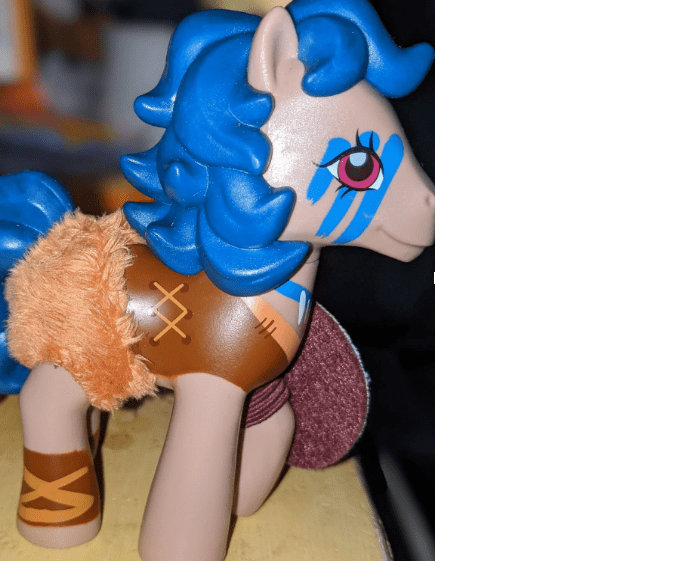
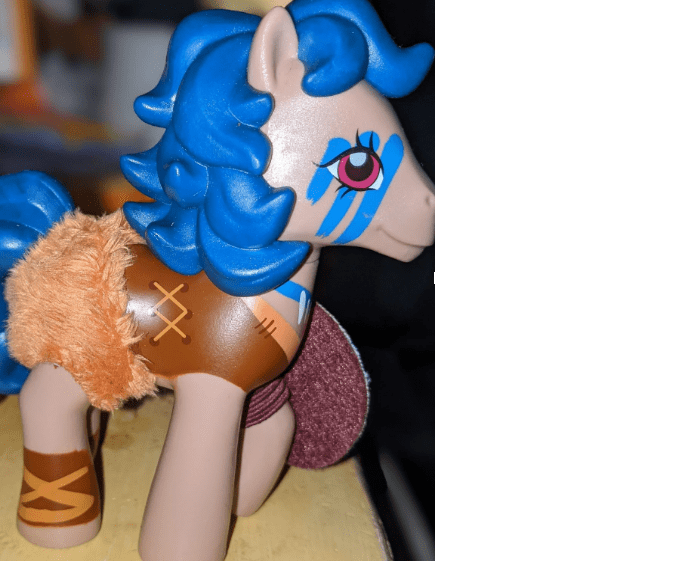
Which brings us back to the My Little Ponies. Here is a photo of my pony who is dressed as a barbarian. She has many markers of being “wild,”i.e. culturally non-Western. She has tribal(??) eye paint, is wearing animal skins, has a tooth necklace and wears a fur diaper. She carries a wooden shield. Per the back of the box, her highest stats are strength and constitution. Her companion in the right-hand picture is a bard. She wears an intricately decorated cape and carries a western instrument —a lute. Her highest stats are charisma and intelligence.
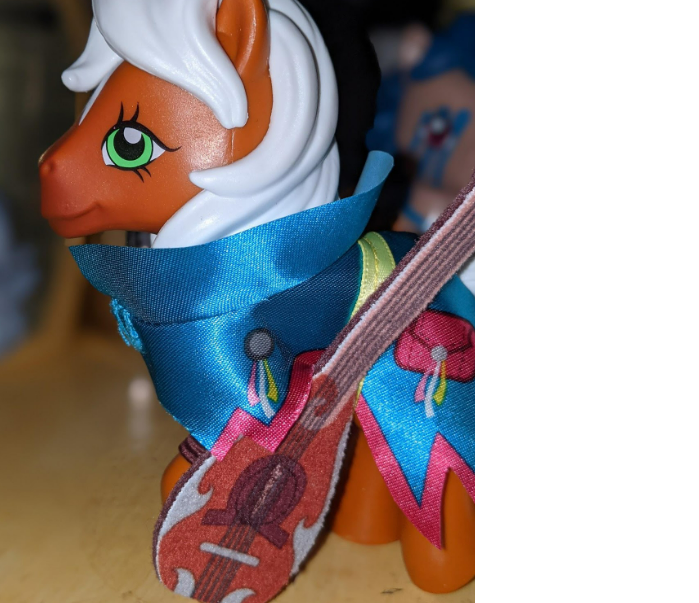
So this begs the question, why would someone choose to use a wooden shield and wear a fur diaper, if there are metal shields and effective clothing right there? (In the set, the barbarian is the only one not wearing Western-style fantasy clothing). And while we are on the topic, why would any pony in her right mind choose to play a stringed instrument with hooves? Wouldn’t a drum or panpipes make more sense? Are they too simple for the bard aesthetic? She literally has no fingers. What is the message here?
The reason that The Hulk is a compelling character is that he is at once a berserker and a highly educated intellectual. This is also the crux of the conflict in the story of Dr. Jekyll/ Mr. Hyde. These are two examples of white male characters who are both berserker-style fighters and scientists. Neither wore fur diapers as fashion (although Bruce Banner must have gone through a lot of pairs of pants). There is no reason that someone who is a “barbarian” would wear less sophisticated, less effective clothing than the rest of the group, except to mark her as Other. But really, to what purpose? Why is she coded as culturally different from the other four ponies in her group? The barbarian is coded as less intelligent, less sophisticated, prone to rages, and also as non-western. The bard is coded as intelligent, charismatic, and somehow able to play strings with hooves. Amazing. This is what CRT means about baked-in biases in social institutions.
Now, do I think that the person who designed these ponies is a terrible, racist hatemonger? No, of course not. It’s likely that they have never even played D&D and were simply relying on whatever got sent over from the game nerd department down the hall.
So, the important question becomes this: how do we game nerds keep the elements of fantasy and adventure that brought people to role playing games in the first place, without relying on problematic tropes that serve to continue racist, classist and sexist assumptions?
D&D is a very popular game, but increasingly, the RPG community is discussing other role playing games that do not have this historical baggage – Quest, Kids on Bikes, Powered by the Apocalypse games, Masks, etc. We can, and must, have diverse voices at the table who are not afraid to apply both CRT and historical lenses to our games. This allows us to create a creative narrative fantasy world that does not perpetuate the inequities of our real world. This leaves us free to slay (or bargain with, move in with, romance, save, learn from, etc.) all manner of dragons, monsters and other beings without having to don a fur diaper to do so no matter what our class.
… Although, if you want to wear one, go for it! I’m not yucking your yum. I’m just here waiting for the bard to get so sick of trying to play the lute that she becomes a berserker herself.
Sources
“Barbarian.” Wikipedia, March 10, 2024. https://en.wikipedia.org/wiki/Barbarian.
Barber, Graeme. “Decolonization and Integration in D&D.” POCGamer, February 6, 2019. https://pocgamer.com/archives/1080.
D’Anastasio, Cecilia. “D&D Must Grapple with the Racism in Fantasy.” Wired, January 24, 2021. https://www.wired.com/story/dandd-must-grapple-with-the-racism-in-fantasy/.
Friedlander, Jamie. “Got Qi? What Chinese Medicine Says about Your Body’s Innate Energy.” Healthline, February 26, 2019. https://www.healthline.com/health/ways-to-balance-qi-for-health#qi-deficiency.
Gault, Matthew. “Dungeons & Dragons’ Racial Reckoning Is Long Overdue.” Wired, December 31, 2020. https://www.wired.com/story/dungeons-dragons-diversity/ .
Ghouse, Basheer. “The Truth of Colonialism in D&D.” Fear The Swarth, February 28, 2020. https://feartheswarth.wordpress.com/2020/02/28/the-truth-of-colonialism-in-dd/.
Hasbro. “Cutie Marks & Dragons .” Pawtucket: RI, 2020.
Sawchuk, Stephen. “What Is Critical Race Theory, and Why Is It under Attack?” Education Week, May 6, 2021. https://www.edweek.org/leadership/what-is-critical-race-theory-and-why-is-it-under-attack/2021/05.
About the Author
Maryanne Cullinan is a middle school teacher, PhD student and Academic RPG Researcher. She multi classes as cleric/bard/cat herder. You can check out some of her work on http://www.culliopescauldron.com or say hello @culliope on Discord and Twitter.

 RPG Counterpoint
Leave a reply to moodywarlock Cancel reply