
By: Maryanne Cullinan
On a Friday night at my house, we are playing DnD. Tordek the Cleric and Caraway the Wild Magic Sorcerer are loudly arguing over if Biff the Lich Storekeeper needs to be killed on principle, or principally celebrated for his low low prices. While this happens in fiction, Will, who plays Tordek, explains his thinking – is part of his understanding of clerics that Tordek would feel compelled to kill any lich. Maryanne aka Caraway, jumps up to get something out of the oven. Gary Alan Fine would be so proud!

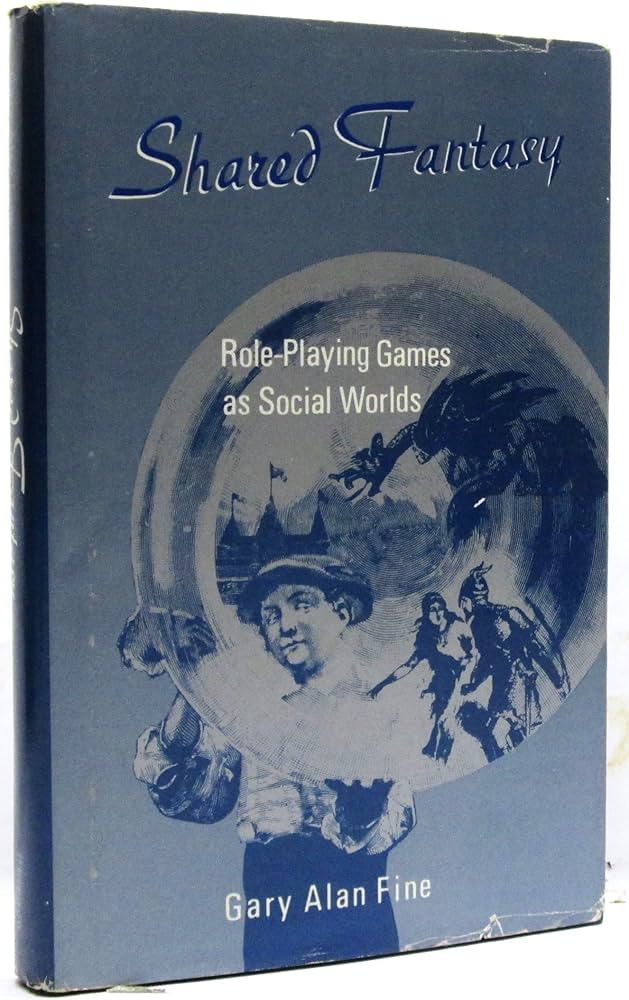
Gary Alan Fine is an American Sociologist who studies subcultures. Way back in 1983, when satanic panic was in full swing, and role-playing games were getting a bad rap, Fine studied RPGers to see what was actually happening in their sessions together. This research was the basis for the book Shared Fantasy: Role Playing Games as Social Worlds. What Fine discovered was that players of RPGs were simultaneously thinking in three different frames of reference at the same time.
Frame One: Player as Self – In this frame, the player is thinking as themselves about their needs. This is the frame of scheduling, getting food, making sure that the chair they are sitting in is comfortable, and being aware of the social needs of their friends. This is the main frame we all live in all of the time, and it doesn’t go away while we are playing together. In the example above, this is when Maryanne the player is taking the fries out of the oven, so everyone can have dinner instead of being too hangry to play.
Frame Two: Player as Strategist – In this frame, the player is thinking about how to “win” the game strategically. In a game like chess, this is easy to see. The player makes strategic moves, may sacrifice some pieces so that others can get into a more advantageous position, or calculate what the opponent might do. In an RPG, winning looks different for different players. Some players like to min/max their characters to fight the most effectively. Others will want to do whatever seems the most narratively interesting, or what they can do to best support their fellow party members. In the example, Will breaks character to reference what he understands about the rules for clerics in DnD 5e, while looking at his character sheet to inform his strategic decisions. This is also the frame we are in when someone is metagaming (using what the player knows or suspects to influence what the characters do in a way that would not happen in fiction.) It can also be seen when people say things like, “above the table, can you remind me of —” or “Maryanne doesn’t know how to train horses, but Caraway would be able to do that no problem.” It is also the frame when people pour over their character sheets to pull out an item they had forgotten about or have their character a spell they think might be useful, based on what they think the DM has in store.
Frame Three: Player as Character – One could argue that all games that are not pure chance require frames one and two thinking of their players. RPGs, however, also require players to be part of a fictional narrative. Players must be in a space of shared fiction to play the game together. They must imagine themselves as their characters. In this way, RPGs are different than chess or soccer, or even video or board games, because they require players to inhabit the psyche of their fictional characters. At our table, we get a lot of laughs out of the characters making choices that are very different than we, the players, would make in our real lives. That’s part of the fun of playing someone different than you.
You may remember the term Dramatic Irony from high school English class. It’s a difference between what the characters in a book or play understand and what the audience knows to be true. In an RPG, the characters and the audience are the same people. Some of the most effective role-playing happens when characters in the game make decisions based on available evidence, but the people playing the game know that this is a flawed choice based on what they know. Will might not feel compelled to kill a store clerk in real life, even if he seemed undead. Will also knows that his little level 6 cleric is going to get his butt handed to him if Biff turns out to actually be a lich. Tordek, however, would feel he must act, based on his oaths.
Understanding Fine’s Frame Theory has allowed me to become both a better player and DM. By recognizing that players are thinking in three frames at once, it has allowed me to have a little more patience and compassion for myself and others as people with human needs. I have found little sewing projects to keep my ADHD hands busy in Frame One, so I can focus more on Frames Two and Three. It has helped me be more cognizant of the need for player breaks, so that Frame One doesn’t overwhelm my players.
Using the concepts from Frame Theory, therapeutic game masters can use the very real elation or frustration in Frame Three fiction to help change thinking patterns in Frame One of their clients.. It feels amazing to save a dying party member in fiction…but if you accidentally burn down the orphanage, no actually children were harmed in the making of the tale! The interplay of frames is why we feel closer to people we journeyed with only fictionally, and allows us to vicariously live the life of a hero (or villain).
Frame Theory has also helped my student players understand the difference between playing a video game MMORPG, where you are trying to get your character to be the most buff and effective tool possible, and a TTRPG – where part of the fun is having a character with flaws, who gets themselves into trouble. We can recognize that we, as strategic Frame Two players, may want to handle something one way, given the information we know and our bigger perspective. However, as Frame Three fictional characters, we may not know or understand the big picture. Acknowledging that fact openly allows them to let go of the most objectively strategic choice. The dramatic irony is part of the fun. Plus, the unexpected results of a roll can make for a really great story.
So back at my house, Caraway and Tordek are furious. Pots are flying, epithets exchanged, and the entire tavern woken up. It may take weeks for those two to see eye to eye again. But Will and Maryanne are laughing through the argument, as their characters bicker. Everyone is eating fresh french-fries and celebrating the end of the work week. This is why we love to play these games together, and thanks to Fine, we can better describe it.
Fine, Gary Alan. Shared fantasy: Role playing games as social worlds. University of Chicago Press, 2002.
Kilmer, Elizabeth, Jennifer Rubin, Michael Scanlon, and Jared Kilmer. “Therapeutically Applied Rpgs to Support Adolescent Social Connection and Growth during the COVID-19 Pandemic.” Journal of Creativity in Mental Health, July 31, 2023, 1–22. https://doi.org/10.1080/15401383.2023.2239703.
About the Author
Maryanne Cullinan is a middle school teacher, PhD student and Academic RPG Researcher. She multi classes as cleric/bard/cat herder. You can check out some of her work on http://www.culliopescauldron.com or say hello @culliope on Discord and Twitter.
Leave a Reply to Happy 2nd year Anniversary to RPG Counterpoint! – RPGCounterPointCancel reply