
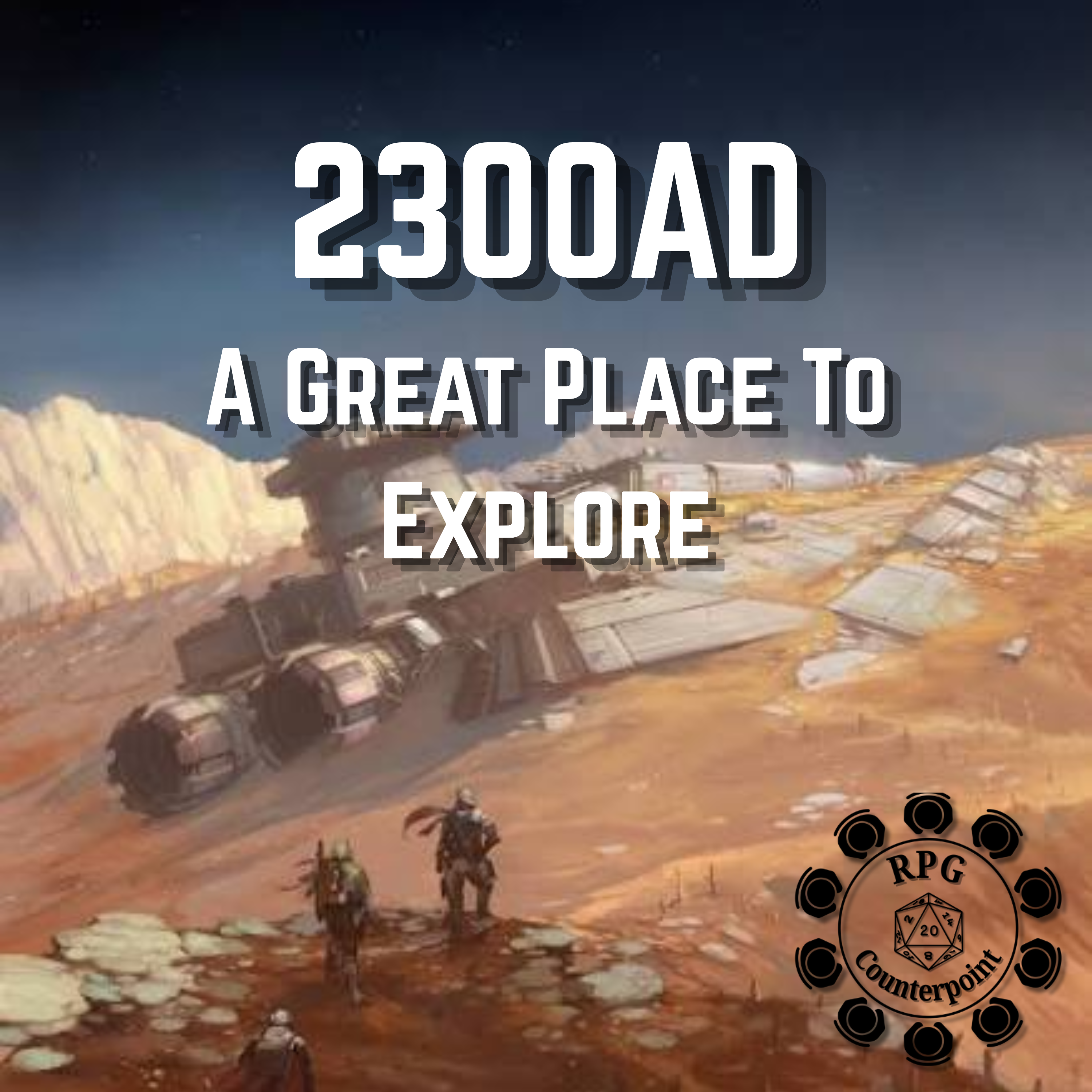
A Review by Mark G.
Before I take a dive into reviewing the Mongoose 2nd Edition (MG2E) publication of the 2300AD setting, it may help to provide a little context of who I am, and my experience with TTRPGs. I’m 57 years old, and first started playing during the “Satanic Panic” of the 80s. The majority of my experience is with the various editions of Dungeons and Dragons.
I was first introduced to the game of 2300AD in the late 80s, when it was published by the now-defunct Game Designers Workshop (GDW). Sci-fi TTRPGs were not generally as well-known at that time, and it was a nice change of pace from D&D.
One of the things that really grabbed my attention was the 2300AD setting was that it took place three centuries after the “Twilight War” (which was the setting for another GDW product, “Twilight: 2000”), the setting depicted how Earth and its inhabitants had recovered in the aftermath of that war. While nuclear weapons had been used, there was never a total release. There was enough civilization and infrastructure left to help rebuild. Without getting too far into the weeds of the Twilight setting, France ended up becoming a financial powerhouse and a world financial and scientific leader. They spearheaded exploration of our solar system, and the development of the “Stutterwarp Drive,” a FTL drive that utilizes quantum tunneling.

The Stutterwarp drive allowed exploration beyond our system, and the colonization of a world in the Proxima Centauri system. Eventually, forty-six colonies would follow on twenty-eight worlds, spread among three colonization Arms, each named for the primary power that colonized them: American, French, and Manchurian.
This leads into two of my favorite things about the setting: the shift in polities and their power dynamics, and the frontier nature of most of the worlds. As a result of the Twilight War, certain polities changed drastically, perhaps highlighted the best by China now being three separate countries: Canton, China, and Manchuria. Rather than a single, monolithic political entity, they may be at cross-purposes throughout explored space, and it can (and does) vary from colony to colony. Texas is its own separate country, as well (which may make any residents of that state who play the game happy!) Countries are graded as to what Tier they belong in, from 1 through 6, which represents that nation’s status and power. France, as the economic and scientific powerhouse it is, sits in Tier 1, along with its holdings around the globe. Tier 2 is occupied by the United States, Britain, Japan, Manchuria, and the German Federation. Tier 3 contains Canada, Texas, Australia, and a myriad of others who have some presence in off-world colonies, but can’t truly project much power.
Unlike a lot of other sci-fi settings, both in TTRPGs and in visual media, there isn’t any “gravity plating” to allow folks to move around ships as if they were on the ground. Any artificial gravity is provided by spin habitats on vessels, and not every vessel can spare the space or cost.
Outside of all of the potential for intrigue and conflict with the various nations and their colonies, there are a few alien species we’ve encountered, and none of them have the same relationship with us as the others. From the tree-like Arbors, to the very unique Pentapods, who have focused on biotechnology (including for their starships), to the belligerent Kafers, whom mankind is at war with on the French Arm.
This backdrop provides multiple ways to engage with the setting, encapsulated in these suggested broad campaign themes: Exploration and Alien Contact, Mercenaries, Space Military, Troubleshooting, Trade and Commerce, and Counterterrorism. While most of these are pretty self-explanatory, the “Troubleshooting” one is a nice catch-all, as adventures can really involve some aspect of the rest. As subsets of those themes are the sources of conflict, including (but not limited to) Core worlds versus the Frontier, Organizations versus the Independent colonies, the Hard path (reliance on hardware) versus the Soft path (reliance on biotech and genetic manipulation), Humans versus Aliens, and National Rivalries.
Pulling back from this amazing kaleidoscope of the setting, I now want to have a look at the framework that allows the players and the referee/GM to interface with it. 2300AD is a setting within the Mongoose 2e Traveller game system, much like how there are many settings within the Dungeons and Dragons universe, but all utilize the same base system, albeit with a few tweaks here and there. Traveller is a system that’s been around in various incarnations almost as long as Dungeons and Dragons has been. At its core, Traveller relies on two six-sided dice, or 2d6 in common parlance. Because the system only utilizes d6s, it’s frequently presented as simply “#D”; for example, if a weapon deals 5d6+2 damage, it’s presented as “5D+2”.
The character that you use to interact with the setting is referred to as a Traveller, in place of the more common “PC” for “Player Character”. Unlike Dungeons and Dragons, your Traveller is not considered to be “heroic”, in that you don’t gain levels in a class, and your health typically doesn’t increase, and if it does, it’s after a long time. Your Traveller has six Characteristics that reflect their baseline capabilities: Strength (STR), Dexterity (DEX), Endurance (END), Intellect (INT), Education (EDU), and Social Standing (SOC). STR represents physical strength and forcefulness. DEX is physical coordination, reflexes, and agility. END is stamina, determination, and how much physical damage can be sustained. INT is quickness of mind and reasoning. EDU is what the Traveller has learned and experienced. SOC is where your Traveller lands in society, what sort of influence they wield, and how much clout they may have.
Generating those scores is as easy as rolling 2D for each, arriving at a score from 2 to 12, with 7 being an average score. There is an optional rule that allows two of those rolls to be made with Boon, which is a mechanic similar to “Advantage” in 5th Edition Dungeons and Dragons; with Boon, you roll 3D and take the two best. These Characteristics provide Dice Modifiers, often referred to as “DM”, depending on their value. A score of zero is a DM-3 (although your Traveller is likely deceased at that point, depending on which Characteristic it is), with 1 and 2 providing DM-2, 3 to 5 providing DM-1, 6 through 8 are DM 0, 9 to 11 are DM+1, 12 to 14 are DM+2, and 15+ is DM+3.

But wait, you ask, how do you get a score above 12 if you only get 2D to generate them? That’s where the Career system comes in. You progress your Traveller through character generation in four-year chunks, called “terms”. For each term, you are in a Career, often of your choosing, but sometimes not. For most Careers, you have to succeed on a 2D roll to qualify to enter it, presented in a format like this: INT 6+; this means to successfully qualify, you must roll 6 or higher on 2D, with a DM from your INT score. So, if your Traveller’s INT score is 9 to 11, that Qualifying roll would be 2D with a DM+1. Within each Career are three Assignments, roughly analogous to a “subclass” in Dungeons and Dragons. For example, under the Agent Career are the Law Enforcement, Intelligence, and Corporate Assignments. Each Career and Assignment dictates what skills you have access to as you progress through each term. It’s also possible to improve Characteristics as part of this process, but that’s in lieu of gaining or improving a skill, so choose wisely. To a certain extent, you, as the player, have some control over how many terms you go through before mustering out to take up the adventuring life. This system does its best to emulate the randomness of a lived life and what you gain and learn from it. As part of the mustering out process from a career, you determine what assets, if any, you start with, in terms of currency and/or equipment. You may even start play with partial ownership of some sort of vessel.
This brings me back to the 2300AD setting, because the default Traveller setting, “Charted Space,” has literally thousands of worlds to explore. That can be very overwhelming for a GM to face; with far fewer worlds to contend with, 2300AD is much easier to manage. I also appreciate the more grounded technology and “gritty” frontier feel.
Mongoose Publishing puts out an overall solid product. The only things I will mark them down for are a need for better copy editing and proofreading. The books are very solid quality, their customer service is good and prompt, and if you purchase a physical copy of a product, you also gain access to it as a PDF download.
About the Author
Mark G has been playing TTRPGs for about four and a half decades now, starting during the infamous “Satanic Panic” of the 80’s. He finds them to be a near constant source of entertainment and one of his favorite creative outlets. The majority of his experience is with Dungeons and Dragons in its various iterations, but has branched out to several beyond that.
Leave a Reply